

How to Work with a Consultant
At GLTAAC we help our client manufacturing companies by covering 50% of the cost for third-party experts (i.e., consultants) on crucial projects to improve their competitiveness. Many clients identify this outside expertise themselves. For others, we help them identify, select, and secure the best outside expertise (typically a professional consultant, but not always) for each improvement project.
We’ve helped hundreds of client companies successfully work with hundreds of consultants over the years on all kinds of projects (market planning, website development, sales training, lean manufacturing help, quality certifications, employee skills training, succession planning, to name just a very few).
We have learned that the way a company approaches working with a consultant can be a big determinant of how successful the engagement ultimately turns out. So, let’s take a look at how to do that.
For this blog, I’ll assume that you have already found a consultant. If you need ideas to help with that, see GLTAAC Project Manager, Parker Finn’s previous blog “The Right Way to Find a Consultant – 6 Basic Steps”.
Start right
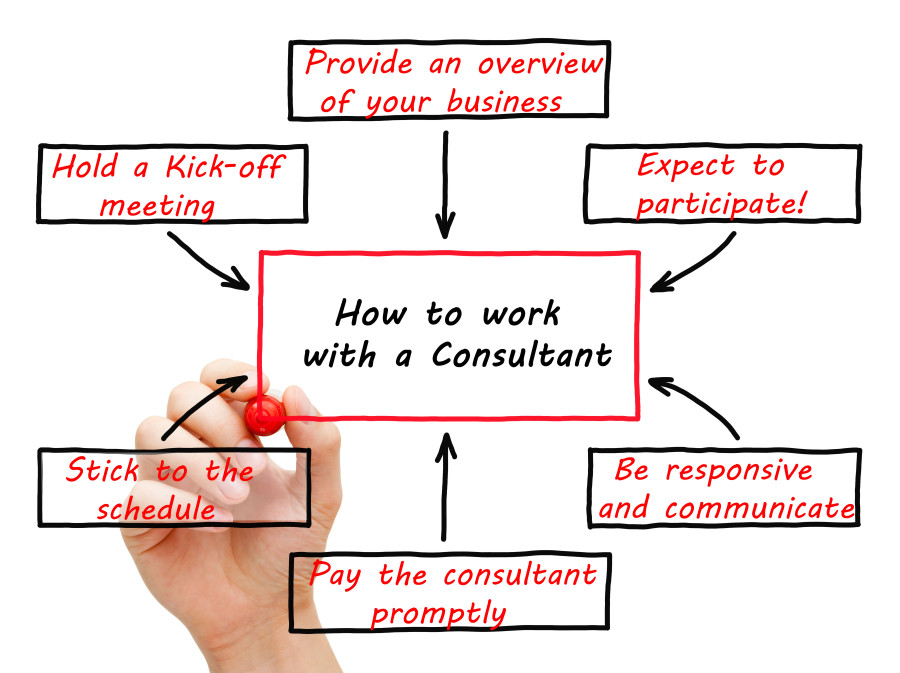 OK, so you’ve found a consultant and you’ve signed an agreement with them that has a defined scope of work with deliverables and a timeline with milestones. Before signing, you went over the agreement and clarified any details so there is no confusion and so invoicing will be clear. Good – now the work begins.
If this is your first engagement with the consultant, they’ll need to spend some time to understand your business and your company. Do your part to give them a quick, thorough understanding of the relevant parts of your business – it will help them be productive more quickly and set the stage for a good relationship.
Have an appropriate kick-off meeting so your staff is aware of the expectations and schedule for the project. This will help insure you have the needed support in your company. Share the details of the agreement with your staff – they will help you manage the effort.
For the duration of the project the consultant will be your partner, applying their expertise to help you accomplish your business goal – whether that goal is in marketing, sales, manufacturing, quality or some other area. Take the long view – when the project is successful, you will want to call on them in the future for similar work.
Expect to participate
Be involved in all aspects of the engagement. Expect to spend some time handling logistics, attending status meetings or phone conferences, and handling internal communications with stakeholders. Establish good communications (i.e., exchange email, office phone and cell phone numbers!) and stay in touch with the consultant.
M ake sure you and your staff are available as agreed and that you and your staff do your “assignments” (if any) as needed in order to stay on schedule. Whether it is an approval of the consultant’s work product or providing some information to the consultant so they can continue their work, manage your end to be sure it is completed on time. If your company does not do its part, it undermines the consultant’s effort. If you keep the consultant waiting, they will have to switch their efforts to another client while they are waiting. Once momentum is lost, it is hard to re-start the effort and recapture the momentum and enthusiasm.
When a project is late, our experience is that often it’s the client who has delayed the work by not responding to the consultant. The press of daily business can cause staff to be “too busy” to provide the needed information or approval. GLTAAC asks our clients to grade each consultant after every project and we’ve found that the lowest scores tend to be for timeliness and accessibility. When we discuss it with the client, they often admit that delays started with their own delay in providing information to the consultant.
Remember, it’s a business – pay promptly!
Consultants basically have two things to sell: their time and their expertise. They offer them in exchange for fees and, like any other business, they depend on prompt payment of those fees to sustain their business.
Often, the best consultants for our client companies are small firms who have just a few employees. For them, cash flow is critical. The best way you can show appreciation for their services is to pay promptly.
Formula for success
To summarize, the best way to work with a consultant is to have an agreement in place with a clear timeline and clear deliverables.
• Start out right with a kick-off meeting
• Expect to participate – be involved and stay in communication
• Manage the engagement to keep the momentum and enthusiasm
• Pay the consultant timely
Consultants genuinely want to help their clients succeed. As with all good relationships, successful consulting projects require mutual respect, ethical behavior, and a willingness to work together toward specific goals.
Contact GLTAAC for more information about the TAAF program and the kinds of projects we co-fund for our clients.

The Right Way to Find a Consultant– 6 Basic Steps
If you are managing a manufacturing firm, you are well aware of the range of capabilities needed to operate your business at the highest levels. Lean practices need to be deployed in manufacturing for cost-competitiveness, speed and efficiency. Long-time customers are cutting jobs, and new customers need to be found. Even with an experienced staff, you need an expert to help you jump start these initiatives. Taking smart steps to find and hire the right consultant can make the difference between mediocre results and great results that will propel your business.
The Great Lakes TAAC has helped hundreds of small and mid-size manufacturers connect with consultants, designers and trainers on a range of projects. This blog post shares our best advice for making your project go well, in 6 basic steps. (Spoiler alert: much of a project’s success has to do with you.)
Step 1: Define goals
 The best first step for finding the right resource is defining well what you need. Understanding your goals for the project, what you hope to attain, and what help is needed is vital. For instance, you may have set a goal to generate 50% of sales from new accounts. That is not enough to hire a consultant though. You first need to understand your current-state marketing and sales efforts, and what new resources will be needed to diversify. Do you need market research to identify new customers? Do you have the necessary website and social media tools to reach new customers? Does your sales team know how to sell into new markets? At this more detailed level, you can define a meaningful project with specific goals, such as a market research report, Internet marketing plan, or sales training.
- This process can be iterative as you meet with consultants. You may better understand your needs after talking with people who ask good questions. Better project definition early on will help you with your selection process.
Step 2: Identify potential consultants
Reach out to professional colleagues, industry associations, local schools and economic development groups to find potential consultants. It is likely you have professional or personal contacts that have tackled the same project. They will be able to give you firsthand recommendations of people to consider. Your CPA firm or legal advisor may also know of resources, especially if they work with similar firms in your industry.
For a cold search, LinkedIn is probably a safer bet than Google. You can search by keyword, location and past titles and employers. This may be particularly useful if you are seeking a specific technical expertise.
The Great Lakes TAAC has worked with many consultants in the past and often recommends consultants for our clients to consider.
Step 3: Bid the project
Once your project is well defined and you have consultants to consider, create an RFP document (request for proposal) and send it to your list of consultants. Provide some background, scope, and expected outcomes. Sharing the same scope and goal for the project with each consultant gives everyone an opportunity to respond. Give a timeline for your evaluation and selection, and be sure to give each respondent a chance to discuss with you, ideally in person on site.
- By bidding, you are not aiming to select the “lowest cost”. The goal is to find the best overall fit for the project. Cost is only one factor to consider.
Step 4: Evaluate and score your options

When making your selection, you will evaluate the written proposals along with your impression of the consultant through your interactions. Your in-person impressions matter as part of the process. But don’t simply make your decision based on information packed presentations, such as an eye opening presentation on Internet marketing. Good presentations are great, but you need to know specifically at this point what the consultant will provide. Is it training? How many hours and for how many months? Is it a new website and Internet marketing plan? Who is writing the website copy? What will the consultant provide each month for your Internet marketing? Get the job tasks a la carte so you can focus on what you need. Be sure to have a total expected dollar amount and timeline. Have milestones to evaluate progress. Have a timeline. (More on this in GLTAAC’s next blog post)
Importantly, the evaluation of proposals should include a scoring metric to help rank options. The scoring can be simple, such as 100 possible points across key measures. For example: 45 – experience, 30 – understanding, 15 – timeline, and 10 – price. Ideally, have three team members score proposals separately. Based on our experience at GLTAAC, it is surprising how often different people will score the proposals similarly. This builds confidence in your selection and gives a quantitative measure for discussion.
- For a bigger project, it is worthwhile to ask for references. This is appropriate when you’ve narrowed your options, are satisfied with the proposal, and are seriously considering hiring the consultant. The consultant’s past clients are busy people, and they’d only care to request their reference if they are being considered for a job.
- Be wary when someone says they can’t share their approach or process because it’s “proprietary”. An experienced consultant should be able to walk you through how they will work with you without giving away any proprietary methods. To be fair, any materials a consultant uses in their work (such as questionnaires or work tools) need not be shared. But if they can’t describe their process, they probably don’t have their own work approach well defined. A technical project in engineering or science will have more proprietary elements.
Lastly, you need to be involved. Good consultants are evaluating you as well. Look for someone who asks good and challenging questions. A good consultant wants you to be successful, they need to know how they can help, and they need you to be involved. Understand what resources you will need to provide. Is it training? Make sure your team is available. Is it a strategic marketing plan? Make sure your sales and marketing people are ready to contribute. You should understand your organization’s role in the project through the selection process.
Step 5: Create a contract

Once you have made your selection, make sure to include the appropriate details in the contract. At this point, the scope of work, timeline, and cost should all be understood from the proposal. Were some proposal details clarified in a follow up phone call or meeting? Putting the details in writing helps avoid confusion, and billing will be clear. Set specific milestones so that you can evaluate progress.
Step 6: Moving forward
Be sure to thank the other bidders and offer feedback if appropriate. Were there other strong candidates? Be sure to keep good resources in mind if others ask you for a suggestion. Recommend them to others.
With a little investment of time and effort up front, you’ll find the right fit and have a much more successful project. The benefits to your firm can be enormous, and your people will get more out of the project.
Now that you’ve selected your consultant, have a look at the GLTAAC post “How to Work with a Consultant.”
West Michigan-Based AVIO-TECH LTD. Profiled in MIBIZ
In September 2020, MiBiz profiled West Michigan-based Avio-Tech Ltd. and the TAAF program in their online publication. As a result, the article titled Great Lakes trade center helps manufacturers compete with imports reached nearly 100,000 readers in West, Southwest and Central Michigan.
Avio-Tech Company President Lee Thomas said he saw the GLTAAC program as a worthwhile venture. Read more about Thomas’ two measures of success and the full MiBiz article here…https://bit.ly/3l55qI5
Mursix Corporation Profiled in Metalforming Magazine
In May 2019, MetalForming Magazine profiled Indiana-based Mursix Corporation and the TAAF program in their monthly publication. As a result, the article titled Metal Former Stays Strong With Aid From Government Program reached nearly 53,000 Precision Metalforming Association readers.
This article highlighted TAAF in two ways:
See how the TAAF program worked for GLTAAC client Mursix Corp (Indiana). “Mursix executives want others to know about and perhaps benefit from what they learned: Help is available through the Trade Adjustment Assistance for Firms (TAAF) program…”
In addition, Editor Joe Jancsurak wrote a companion editorial: “Hurt by Foreign Competition? Help’s Available” (read it ).
Read the full MetalForming Magazine article here…
TAAF Program Featured in Michigan Manufacturers Association’s MIMFG Magazine
In July 2020, the Michigan Manufacturers Association profiled the TAAF program in their monthly MiMfg Magazine. As a result the article, titled Federal Program Helps Michigan Manufacturers Beat Import Competition, reached nearly 1,700 member companies across Michigan.
Joe Dobrowolski, President of Superior Fabrication (also an MMA member), explains his experience with GLTAAC and TAAF:
“Superior Fabrication Co., LLC engaged Great Lakes TAAC for support and assistance after loss of business to offshore competition. From the beginning, it was apparent the process was one of true professional development. The GLTAAC Team’s helpfulness in supporting growth through consultative expertise and process provided a path for change. The Team truly engages with the business to understand issues and works diligently to provide avenues for improvement, development and success.”
Read the full MiMfg Magazine article here…

Why Should You Care About Your Cybersecurity?
GLTAAC is part of the Economic Growth Institute, which also houses the Defense Cybersecurity Assurance Program. This blog entry, written by DCAP’s Ashlee Breitner, explores cybersecurity issues that even a small manufacturer faces.(More on DCAP below – including information about their free seminars).
—
Ten years ago cybersecurity used to be what most thought was a just buzzword, but in today’s world with ransomware, phishing and viruses hitting all industries, it’s not something to be taken lightly.
You might think, “I’m just a machine shop”, why would anyone ever want to cyber attack my company?” Consider this case: In 2019, in a small rural city in Michigan, ransomware infiltrated and held hostage the systems of every company within one small industrial park, demanding $25,000 from each. The attacker did not care if it was an equipment dealer, a fabricator, a media company or a bank. The only company that survived this attack without having to pay the ransom was a small defense contractor that had just made an investment to assess and secure its cyber and physical security. This investment, with DCAP grant funding support, cost the company under $5,000. That means the company saved over $20,000 from just that single attack.
When thinking about your cybersecurity risk, ask yourself these questions:
1. Have you conducted a cybersecurity assessment of your business? If yes, do you have a written company cyber incident response plan?
- If no, what would you do if you were attacked? Do you know where to start?
2. Have you ever had a cyber breach?
- If no, how do you know?
3. Has your staff undergone security awareness training?
- If yes, how often are they retrained?
- If no, would they know what to do if there was an attack? Even more importantly, do they know how to avoid attacks?
4. Are any of your products potentially used in the defense industry?
- If yes, did you know there is a new mandate in 2020 for all companies in the defense supply chain, regardless of their type of business, to be certified to the Cybersecurity Maturity Model Certification Program created by the DoD?
If you’re ready to prepare for a possible attack, where do you start?
1. Assess Your Risks
There are many free resources available to help you conduct a self-assessment of the risks to your company. The US SBA office references a series of vetted assessment tools to get you started. Check out the Small Business Cybersecurity information at this link.
2. Address Your Risks
This is where most companies fall short and become vulnerable. Starting with your highest risk first, define a plan of how and when you will tackle it and each subsequent risk. This honestly is where a trusted outside consultant can be of most help. They will help keep you on track as you implement your action plan. Otherwise life…business…and everything else, will always take priority.
3. Continuously Monitor
Just setting a plan and working toward resolving your risks is not enough. Risk is an ever changing factor and it is important to set a regular frequency to re-evaluate your risks.
Where can small manufacturers get help?
- GLTAAC clients can receive matching funds for cybersecurity preparedness projects. To learn more about the TAAF program eligibility, contact GLTAAC today.
- If your firm is in Michigan, Indiana, or Ohio, Ashlee’s DCAP team can help in several ways:
- Free Cybersecurity Seminars in the spring of 2020: Click here to visit the DCAP web page, which includes the seminar schedule and links to register.
-
- Grant funding and guidance: Smaller manufacturers in Michigan, Indiana, and Ohio that are in the defense supply chain should look in to support and funding via the Defense Cybersecurity Assurance Program (DCAP).
- Learn more about eligibility by visiting the DCAP web page, or contacting the team at umegi-dcap@umich.edu.
- Grant funding and guidance: Smaller manufacturers in Michigan, Indiana, and Ohio that are in the defense supply chain should look in to support and funding via the Defense Cybersecurity Assurance Program (DCAP).
- For more reading about Small Businesses and Cybersecurity, have a look at The U.S. Department of Commerce post: Ten Cybersecurity Tips for Small Businesses
On the Road in Michigan
GLTAAC team members have been covering a lot of miles as we’ve traveled across Michigan to share information and resources about the TAAF program with our economic development referral partners. In September we presented at the Region 5, 6, 7 (18 counties!) MEDC Toolbox Training in Frankenmuth for business development managers and local and regional economic development professionals. Scott Phillips provided a detailed presentation on the TAAF program to over 90 attendees, provided project examples, and detailed how easy it can be to determine whether a company may qualify for the program. We are very excited about the connections we made and look forward to qualifying companies in this region.
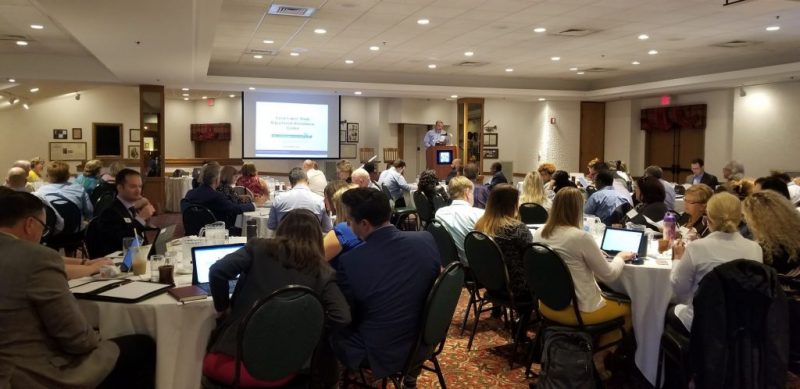
In August the team presented and provided resources to over 25 economic development professionals from the Great Lakes Bay Regional Alliance in Freeland. We have provided follow up with customized Import Exposure Reports to all 8 counties and are working with prospects in the region.
Earlier in the year we attended the MEDA Spring Economic Development Toolbox in Lansing, presenting the TAAF program to over 100 economic development attendees from across the state. We also met with The Right Place in Grand Rapids presenting directly to the business development team and members of their leadership team. Here is a link to the West Michigan Region Import Exposure Summary.
We would like to partner with your local or regional economic development group to share this funding opportunity with your members and serve as an additional resource in the industry. We would be happy to come to an upcoming meeting to present the TAAF program, create a customized Import Exposure Report for your county, or include our information in your online resource page. Please contact us to discuss your needs.
Is Your Focus the Shop Floor?
If the shop floor is your primary area of focus, you might want to consider adding the capabilities of a Manufacturing Execution System to your company tool kit.
What is an MES?
A Manufacturing Execution System (MES) manages and reports on what is happening on the shop floor. This exclusive focus sets MES systems apart from ERP (Enterprise Resource System) systems, which manage a broader range of business operations. Some ERPs include components of an MES, but there are standalone MES systems, which can communicate with ERP systems.
One way to conceptualize the boundaries between MES and ERP is the Hierarchy for Enterprise and Control System Integration. This model is part of ANSI/ISA-95 which is a standard created by the International Society of Automation, in partnership with the American National Standards Institute (ANSI) to define consistent terminology and allow for better integration between manufacturers and suppliers. The hierarchy defines four different levels of enterprise and control systems as shown below. Based on this hierarchy, ERPs are classified as a level 4 systems while MES’s are part of level 3.
ANSI/ISA 95 Hierarchy for Enterprise and Control System Integration
Source: Åkerman, Magnus. (2018). Implementing Shop Floor IT for Industry 4.0.
Data Collection
MES systems collect large amounts of data and present it in a way that makes it easier to maximize efficiency, reduce costs, and ensure quality. The ways in which data are collected can vary from system to system. Often multiple methods of data collection are possible including bar code scanning, RFID tags, direct machine data acquisition, and operator (manual) data entry.
MES Key Functions
A comprehensive shop floor solution, the Manufacturing Execution System will manage, optimize and report on all processes involved in the manufacturing process:
- Materials Management: Ensure parts and raw materials are available without overstocking.
- Scheduling: Optimize labor and machine time to meet deadlines.
- Process Management: Know where every job stands. If changes are made by management such as updating the routing of an order or certain jobs are prioritized, operators will be updated in real time.
- Document Management: Ensure work instructions, engineering drawings, and other critical documents are up to date and in the right place at the right time.
- Quality Control: Automate quality checks and receive alerts so that problems can be addressed in a timely fashion.
- Cost Analysis: Compare actual costs to expected costs and track the profitability of each job.
- Real-Time Data & Visibility: MES systems allow real-time reporting on a wide range of metrics.
Benefits of MES
The ability to monitor, assess and optimize the production process in real time provides numerous benefits including reduced scrap and labor costs, decreased order lead time, and increased customer satisfaction.
Though the benefits will differ depending on each facility’s unique circumstances, one study sought to determine if the benefits from reduced labor overhead alone could justify an investment in a MES. This study analyzed a variety of activities at one injection molding plant and found that, after the installation of an MES, labor overhead was reduced by 19% for planning, 44% for work orders processing, 60% for manufacturing execution, and 76% for data recording and reporting[i]. This study only analyzed one plant and only considered one benefit—reduced labor overhead—so it is important not to assume that similar results will be realized in all circumstances. However, it does provide data to support that a well implemented MES system can offer significant benefits and cost savings.
GLTAAC Can Help
Implementing an MES solution can deliver a wide range of operational benefits across the manufacturing floor. GLTAAC has experience working with clients who pursue MES System selection as one of their co-funded TAAF projects. To find out more, please contact the Great Lakes Trade Adjustment Center at 734-998-6227.
_________________________________
[i] Nasarwanji, A., Pearce, D., Khoudian, P., & Worcester, R.E. (2009). The impact of manufacturing execution systems on labor overheads.
GLTAAC Clients Outperform Manufacturing Sector in 2018
The Great Lakes TAAC collects performance data from the companies it works with every year as part of our internal evaluation process and program improvement efforts. Last year’s survey included 88 manufacturers located throughout Indiana, Michigan, and Ohio. The results were strong. Indeed, GLTAAC’s established clients and recent program grads (“GLTAAC firms”) outperformed the manufacturing sector as a whole!
Sales: 10.5% vs. 7.0%
According the Census Bureau’s M3 report1, total shipments (or sales) by U.S. manufacturers increased by 7.0% in 2018. GLTAAC firms posted an average sales increase of 10.5% last year. The increase was also broad-based – 71% of GLTAAC firms grew sales in 2018.
Job Growth: 3.0% vs. 2.1%
GLTAAC firms increased employment by an average of 3.0% in 2018. Per BLS numbers, total manufacturing sector employment increased by only 2.1% in both the U.S. and the tri-state region of Indiana-Michigan-Ohio during that time.2
It’s About More Than Sales and Employment
GLTAAC collects, compiles, and analyzes other key performance info from its established clients and recent program grads. Additional findings from this year’s survey include:
- Better Bottom-line Performance – 78% of GLTAAC firms were profitable in 2018 (under half were profitable when starting the program).
- Improved Competitiveness – 69% improved their productivity last year, while 82% reported that they are more competitive now than they were before working with GLTAAC.
- Significant Long–term Impact – GLTAAC firms have increased sales by an average of 43% since starting the program, and grown jobs by an average of 27%.
High Firm Survival
The Great Lakes TAAC currently has a 97% 5-year survival rate (meaning 97% of all of the companies we’ve assisted since 1/1/2014 are still in business). This is the single most important metric we track.
It’s important to remember that in order to qualify for TAAF a company must be distressed. And this distress is often severe. The companies discussed above had lost an average of 17% of their sales, and 18% of their workforces, in just the year before starting our program.
We are proud of the impressive results achieved by our clients and appreciate the opportunity to work with them to improve their businesses.
To learn more about how we assist firms, take a look at a few of our GLTAAC client success stories.
If you know of an import-challenged firm that could use help from GLTAAC and TAAF matching funds, contact us to learn more about the program.
Sources
1. Click here for the Census Bureau’s M3 report
2. BLS (Bureau of Labor Statistics) series CEU3000000001, and SMU18000003000000001 + SMU26000003000000001 + SMU39000003000000001
Central Ohio Import Impact
Scott Phillips from GLTAAC attended the April meeting hosted on the Ohio State University campus by the Ohio Manufacturing Institute (OMI). The event speakers included Kathryn Kelley from OMI and Dorinda Byers, Growth Advisor with the newly formed Manufacturing Extension Partnership (MEP) at The Ohio State University South Centers in Piketon, OH. The Ohio MEP Network works with more than 1,000 manufacturers each year to implement on-site projects, conduct training and connect manufacturers to resources and partners throughout the state. Scott shared information with the attendees regarding the Central Ohio import impact on the regional manufacturing base.
Center for Design and Manufacturing Excellence.
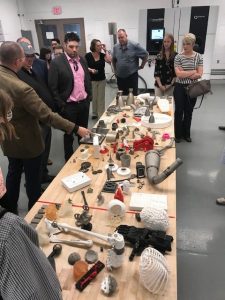 The meeting included a tour of the new 3D Printing Lab at the OSU Center for Design and Manufacturing Excellence. CDME was developed to meet the translational research needs of the university’s external partners. The center was funded initially via a $6.8M federal grant and by the The Ohio State University’s College of Engineering to ensure that university innovation provides a more direct impact on the commercial manufacturing industry. Nate Ames from CDME gave the MODE attendees a tour of the new 3D Printing lab.
Center for Automotive Research
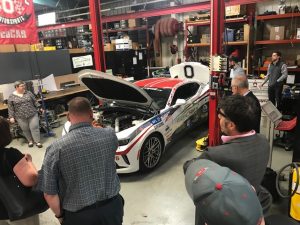 Jennifer Humphrey, Events Coordinator from the Center for Automotive Research then gave MODE attendees a tour of their facilities. The Center for Automotive Research (CAR) is the preeminent research center in sustainable and safe mobility in the United States and an interdisciplinary research center in The Ohio State University’s College of Engineering. With a concentration on preparing the next generation of automotive leaders, CAR is recognized for interdisciplinary emphasis on systems engineering, advanced and unique experimental facilities, collaboration on advanced product development projects with industry, and a balance of government and privately sponsored research
Mid-Ohio Development Exchange
Mid-Ohio Development Exchange (MODE) is a membership organization of local economic development organizations from throughout the 11-county Columbus Region. MODE provides networking partnership opportunities and programming that increases awareness of economic development issues and best practices to continue to strengthen and grow local economies throughout Central Ohio.
Scott Phillips from GLTAAC shared information regarding the Central Ohio import impact and local import exposure and resources for manufacturers who are struggling to compete with imports. GLTAAC manages the Trade Adjustment Assistance for Firms (TAAF) program (click here for program information) for companies located in Indiana, Michigan and Ohio. GLTAAC also tracks high import exposure industries in our region to help identify companies who can benefit from the TAAF program.
Central Ohio Import Impact
Like many regions in the Great Lakes region, the Central Ohio import impact has been increasing and the Region has been heavily impacted by foreign competitors. At GLTAAC, we track and analyze US imports and their potential impact on manufacturers in our region. With this data, we prepare Import Exposure Profiles down to the regional and county levels to provide our partners with specific information in their area. These reports have proven to be a useful tool to help REDOs and LEDOs understand exposure in their area and identify manufacturing clients who can benefit from TAAF.
At the meeting, GLTAAC provided the Partnership and its 11 LEDO Council partners, with industry specific import exposure information, as detailed below:

98.1 from a total of 811 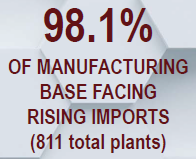 manufacturing manufacturing firms within the Central Ohio region (County Business Patterns, 2016) are in industries that faced rising imports over the past year.

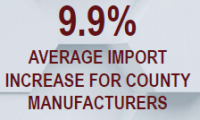 Manufacturers in the Central Ohio region have experienced an average in import increases of about 9.9%, on average, over the past year.
Import Exposure Breakdown
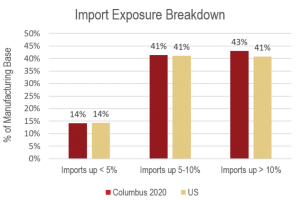
- 98.1% of the manufacturing base in the 11 County Columbus Region are facing rising imports compared to 96.2% for all of the United States.
- The four largest counties with the greatest number of manufacturing plants represent 79% of the entire Columbus Region.
- 6 of the 11 counties face particularly high import exposures with average increases of more than 10%.
Grow Licking County
Nate Strum showed particular interest in the TAAF program as a tool in his toolbox that he can offer to manufacturing firms in Licking County. Nate joined GROW Licking County in December 2015. As Executive Director, Nate serves as the primary point of contact for business and industry attraction and expansion inquiries about Licking County as well as the County’s representative for activities related to the region’s Economic Development Advisory Committee (EDAC).
Click here to see the full report for the Central Ohio Region.
To understand more about import exposure data, click here for an article explaining the data analysis process.
Our goal is to identify TAAF prospects in each county in Indiana, Michigan and Ohio. Let us know if you would like an import exposure profile for your region or county, we would be happy to produce a customized report for you.
State Import Exposure Status
Import Exposure … Wait – There’s More!
As covered in my last blog, GLTAAC is now putting the most current import exposure info available describing manufacturing import exposure in the Great Lakes region on its website. Now, we will also be providing this data at the state level for the 3 states we serve – Indiana, Michigan, and Ohio. Here is the table (with data through 12/31/18.) For an explanation of how to read it, see this. (The explanation uses the regional info, which is also included below.)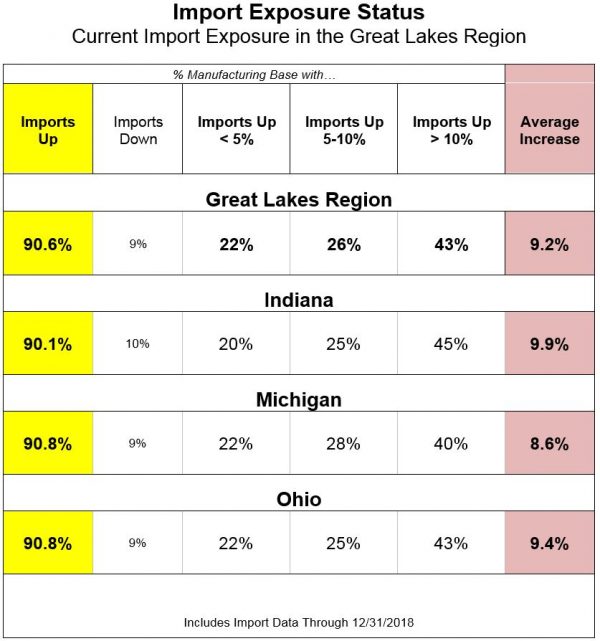 The first thing to notice is that the import exposure status in all 3 states is about the same. This is because their manufacturing bases are very similar. GLTAAC estimates the proportion of the manufacturing base in each state currently facing rising imports (Imports Up) is 90-91% (with Indiana at 90.1% and both Michigan and Ohio at 90.8%). We also estimate that the average increase in imports experienced by manufacturers in each individual state is currently 9-10% (specifically, 8.6% in Michigan, 9.4% in Ohio, and 9.9% in Indiana).
These figures are all very high. However, they do not indicate that 90%+ of manufacturers in our region are presently eligible for the TAAF program. (To qualify for TAAF, a company must both be distressed and a significant portion of their distress must be due to business lost to imports.) Still, import exposure stats are useful, because they offer a sense of how likely it is that foreign competition could be a major contributor to the distress of a struggling company. (When import exposure is high, like now, if a company is losing sales and employment, imports are often at least part of the reason, and many small manufacturers that are distressed could probably qualify for TAAF).
State Differences
Though not as important as the above, the variation in import exposure status between the 3 states is illustrative and interesting. They result from differences in the composition of their manufacturing bases, which can best be seen in the average import increase (Average Increase) figures.
- The intensity of import exposure is currently slightly lower in Michigan (8.6%) than in Ohio and Indiana because (a) it has relatively fewer kitchen cabinet makers (NAICS 337110), who are facing a significantly higher-than-average level of imports (up 20.2% on a year-over-year basis), while at the same time (b) it has a large number of both tool & die shops (333514) and miscellaneous manufacturers (339999), both of which are facing lower than average imports at present (at 5.9%, and 2.2%, respectively).
- Indiana is highest (9.9%), due to its large RV industry (NAICS 336214), which is confronted by extremely high import volumes (currently up 48.3%).
Bottom Line
Import exposure is very high in the Great Lakes region, as well as in each of the 3 states that comprise it – Indiana, Michigan, and Ohio.
Read more:
- For the key points of GLTAAC’s Import Exposure Status, see the blog post Import Exposure Status Updated Monthly
- Go to GLTAAC’s Import Exposure page to view published Import Exposure Profiles for county-level areas, plus the most current regional and state Import Exposure Status.
Ohio Manufacturing in 2019
I recently had the opportunity to attend a reveal of research titled “The State of Ohio Manufacturing in 2019.” The reveal was hosted by the FASTLANE MEP office in Dayton and presented by Ned Hill from the Ohio Manufacturing Institute at The Ohio State University.

This research is conducted annually by the Ohio Manufacturing Extension Partnership (MEP). A free copy of the report for Northeast Ohio can be requested at the Magnet MEP website. Nearly 500 manufacturers throughout Ohio participated in the survey representing 17 different manufacturing sectors across all regions of Ohio.
Here are a few highlights from survey results:
Labor Shortage Challenges
Attracting new workers was ranked by respondents as the most significant barrier to growth, with 27% of respondents indicating that this issue is significantly hampering growth. The biggest challenges in hiring included the following:
- Applicants do not have the needed skills or education
- Lack of applicants for our open positions
- Lack of work ethic, commitment or interest
- Can’t pass the drug test
Investing in Safety & Strategies
In terms of business investment, 15% of firms responded that they had invested in safety equipment or training in 2018 while 14% had launched a new product. In terms of business strategy, manufacturers responded with the following list of strategic focuses:
- Customized manufacturing 40%
- Better quality 19%
- Hi-tech products 17%
- Superior customer service 15%

Investing in Automation
Survey respondents answer questions regarding recent investments in automation on their factory floors. Approximately 55% of all manufacturers have invested in automation with the primary driver being the need to augment their existing workforce. There was a correlation between those manufacturers who invested in automation and their revenue trends. Those with positive revenue growth invested more heavily in automation. Ned Hill noted however that the cause and effect is not clear … “does automation cause revenue growth?” … or “does revenue growth cause automation?”
Conclusion
My conclusion from the research was that Ohio manufacturers, like many other manufacturers in the upper Midwest, need to make sure that they are educating themselves about competitive trends in new technologies – and also preparing their workforce to be in a position to adopt these technologies effectively to improve productivity and profitability.
Import Exposure- Northeast Indiana

In late February, a team from GLTAAC visited the Northeast Indiana Regional Partnership (the Partnership) LEDO Council and presented information regarding local import exposure and resources for manufacturers who are struggling to compete with imports. GLTAAC manages the Trade Adjustment Assistance for Firms (TAAF) program for companies located in Indiana, Michigan and Ohio. We track high import exposure industries in our region to help identify companies who can benefit from the TAAF program.
LEDO Council
The 11-county LEDO Council is comprised of economic development organization representatives in the Northeast Indiana region. They focus on addressing business retention and the needs of companies looking to expand or relocate to Northeast Indiana and the surrounding area. Regional economic development organizations, like Northeast Indiana Regional Partnership, are key referral partners to GLTAAC.
Like many regional economic development organizations in the Great Lakes region, the manufacturing industry base in the Partnership region has been heavily impacted by foreign competitors. At GLTAAC, we track and analyze US imports and their potential impact on manufacturers in our region. With this data, we prepare Import Exposure Profiles down to the regional and county levels to provide our partners with specific information in their area. These reports have proven to be a useful tool to help REDOs and LEDOs understand exposure in their area and identify manufacturing clients who can benefit from TAAF.
At the meeting, GLTAAC provided the Partnership and its 11 LEDO Council partners, with industry specific import exposure information, as detailed below:
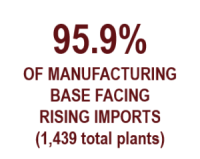
96% from a total of 1,439 manufacturing establishments within the Northeast Indiana region (County Business Patterns, 2016) are in industries that faced rising imports over the past year.
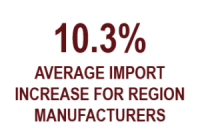
Manufacturers in the Northeast Indiana region have experienced an average in import increases of about 10%, on average, over the past year.
Import Exposure Breakdown
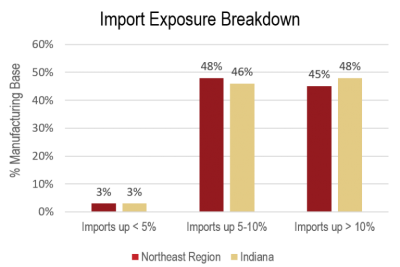
48% of the 1,439 manufacturing establishments belong to industries which have faced an increase in imports from 5 to 10% over the last year. This figure is slightly upward from the State’s number, which is around 46%. 45% of the 1,439 manufacturing establishments in this Region belong to industries which have faced an increase in imports above 10% over the last year. This number is a few points below the 48% State figure.
Steuben & Whitley Counties leverage the information
Prior to the February LEDO Council meeting, Scott Phillips, GLTAAC Senior Project Manager, met with John Sampson, CEO of the Partnership to share the import exposure statistics for the northeast Indiana region and discuss ways GLTAAC can engage with the LEDO Council. Regional and local economic development organizations find the TAAF to be another “arrow in their quiver”, as they look for ways to add value to their clients and stakeholders. As follow up, Phillips completed an outreach meeting with Isaac Lee, Director of the Steuben County EDC which resulted in a manufacturing firm referral in Steuben County. GLTAAC staff conducted post-meeting outreach to each LEDO director, leading to a conversation with Bruce Stach, Business Consultant Whitley County EDC, who will be seeking qualified prospects for the TAAF program.
Click here to see the full report for the Northeast Indiana Region.
To understand more about import exposure data, click here for an article explaining the data analysis process.
Our goal is to identify TAAF prospects in each county in Indiana, Michigan and Ohio. Let us know if you would like an import exposure profile for your region or county, we would be happy to produce a customized report for you.
Import Exposure Status Updated Monthly
Monthly Import Exposure Status Now Online
The Great Lakes TAAC has long tracked and analyzed U.S. imports and the potential import exposure on manufacturers in our region (Indiana, Michigan, and Ohio). However, we’ve recently improved this information and are now going to make it available on our website. GLTAAC will post monthly updates, as the import data are released.
At a glance, GLTAAC’s Import Exposure Status table provides a sense of the breadth and depth of import competition faced by manufacturers in the Great Lakes region. These are macro level metrics, which combine information about (a) the number of manufacturing plants in each industry in the region, and (b) the volume of U.S. imports of the products made by each of those industries. The current import exposure status for our region is given below.
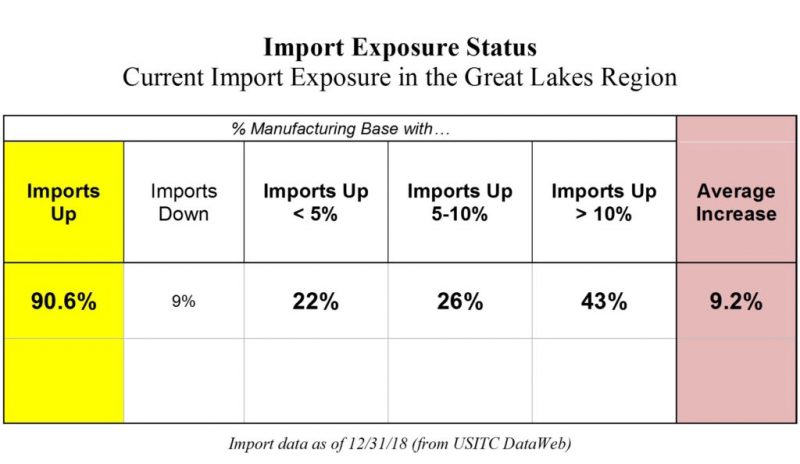
The 2 key numbers in this table are those on the outside.
- Imports Up 90.6% means that GLTAAC estimates 91% of the manufacturing base in Ohio, Indiana, and Michigan is currently facing rising imports (measured on a year-over-year basis).
- Average Increase 9.2% means that the volume of imports faced by all manufacturers in the region has increased by an average of 9% over the past year. (For a more precise explanation of these statistics are how they are calculated, see here.) Viewed historically, 90.6% and 9.2% are both very high.
This does not mean that 90.6% of manufacturers in our region are eligible for the TAAF program. Remember, these are industry-level statistics. And companies qualify for TAAF based upon their individual circumstances. (For more on eligibility requirements, see here.) However, when import exposure stats are high like they are now, if a company is losing sales and employment, it is quite likely that imports are at least part of the reason. (So, many small manufacturers that are distressed could probably qualify for TAAF right now.)
More Detail
The other numbers in the table offer additional detail. They describe the distribution of import exposure across the manufacturing base, and partially disaggregate the first 2 stats. (Returning to the Import Exposure Status table, above) GLTAAC estimates that only 9% of manufacturers are in industries which are experiencing decreasing imports; while 22% are in industries where imports are up less than 5%; 26% are in industries with imports up between 5-10%, and 43% are in industries where imports over the past year have grown by more than 10%.
The value of this distribution can be seen by looking at its change over time. (GLTAAC has been collecting and compiling import data for almost 20 years.) As the note under the Import Exposure Status table indicates, the most current import data available as of this writing is through December 2018. That means all of the numbers are comparing the 12 months ending 12/31/18, to the 12 months ending 12/31/17. (The release of detailed import data typically has a delay of about 2 months, which is actually quite prompt compared to other economic info.) Import numbers for January 2019 will be published shortly. When that happens, GLTAAC will calculate an Import Exposure Status for the 12-months ending 1/31/19, compared to the year ending 1/31/18.
The graph below provides a breakdown of import exposure – the “other numbers” in the table – from January 2011 through December 2018.
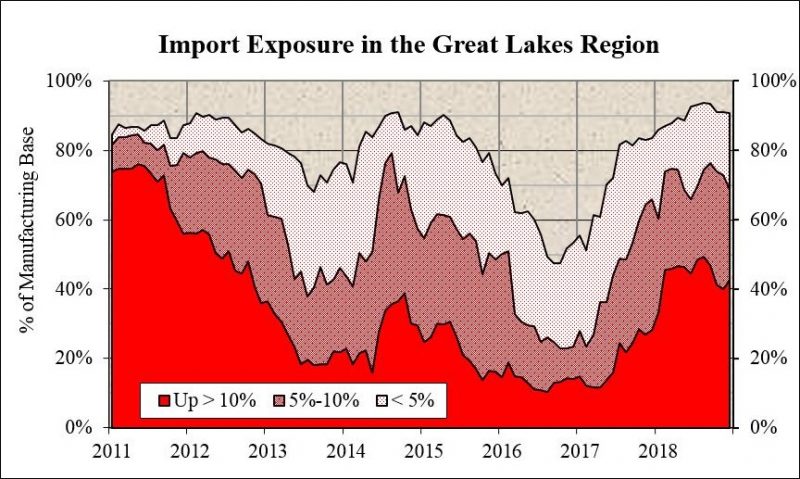
Explanation of Graph – Where the lines hit the vertical axis on the right is the most current data – as of 12/31/18. Note that the first line from the bottom (the one topping the dark red area) hits the right axis at 43% (indicating that an estimated 43% of the region’s manufacturing base was facing imports that increased by more than 10% in CY18 compared to CY17); the next line intersects at 69% (43% + 26%, showing that 26% of the manufacturing base was experience an increase of imports of between 5 and 10%), and the last line hits the axis at 91% (43% + 26% + 22%). These are the numbers in the Import Exposure Status table.
So the graph is just a compilation of import exposure information over time. (Of course each individual point is also a measure over time too – the most current 12 months compared to the prior 12 month period). This compilation is valuable because for most individual companies, the negative impact of imports is cumulative, and the graph provides a sense of that. (Most companies that become negatively impacted by imports lose more and more business over time. It doesn’t happen all at once.) When reviewing the Import Exposure graph, keep in mind:
Visually, the more red, the greater the import exposure over time; and the greater the import exposure, the more likely companies have directly lost business to foreign competitors (and might qualify for the TAAF program).
As can be easily seen, import exposure has increased significantly since late 2016, and it is currently very high.
How the Import Exposure Numbers are Calculated
- Monthly national import numbers compiled by 6-digit NAICS detailed industry (always referred to as just “industry” by GLTAAC) are used to calculate the % change in imports for the most recent 12 months compared to the prior 12 month period. (Meaningful state level import figures are not available.)
- This info is combined with the number of establishments in each industry, which is used to define the total manufacturing base in the Great Lakes region.
- Imports Up = number of establishments in all industries with increasing imports / total number of establishments in the region.
- Imports Down = number of establishments in all industries with decreasing imports / total number of establishments.
- Imports Up < 5% = number of establishments in industries with imports up less than 5% / total number of establishments in all industries.
- Other Imports Up X% = methodology same as Up < 5%.
- Average Increase = weighted average of each individual industry’s % change in imports = the summation of (number of industry establishments)(industry’s % change in imports) / total number establishments in all industries.
Sources
- Imports = Customs Value of Imports for Consumption from the USITC DataWeb aggregated by industry for all manufacturing industries (NAICS 31-33).
- Manufacturing base = establishments by industry from the most recent County Business Patterns (CBP), currently 2016.
Why The Import Exposure Statistics are Estimates
- Data limitations are the primary reason why all of GLTAAC’s import exposure statistics must be considered estimates. Nevertheless, the stats are meaningful and sound.
- First, U.S. import data are used – meaningful state-level information is not available.
- Furthermore, all import data are categorized and collected by Harmonized Tariff Schedule (HTS) code. These codes are then compiled by the USITC into NAICS industry codes. The concordance, however, is imperfect. There are 364 6-digit manufacturing NAICS codes. Only 334 have import data. Those industries without import data are excluded from the calculations. Thus 8% of industries are not included. However, a few of these industries are large, such that 20% of manufacturing establishments have no import data and are thus not included.
- There is a several year lag between the collection of CBP information and its release. The establishment data used is thus somewhat dated.
- Finally, it must be acknowledged that the data themselves are undoubtedly imperfect. (CBP is a survey, not a census; and some imported commodities are miscategorized – sometimes inadvertently, sometimes not.)
- Although these data issues do force some assumptions, GLTAAC does not believe that they significantly skew its import exposure statistics.
Attracting and Retaining Skilled Labor
Attract and Retain Skilled Labor
The U.S. economy added 13,000 manufacturing jobs in January, and employment in the sector has been growing since the end of the Great Recession. That’s good news, but this positive trend does pose a challenge to manufacturers that need more skilled workers. In fact, in a recent survey, 52% of manufacturers identified finding skilled labor as their number one barrier to growth[i]. So what can manufacturing companies do to attract and retain skilled labor?
Unfortunately, there is no silver bullet and implementing an effective recruiting strategy will require an investment in time and resources. However, the suggestions below may help in developing a plan to expand your workforce.
Develop a culture of recruiting
Recruiting should not just be the responsibility of the HR department. Friends, relatives and acquaintances of current employees may offer a large pool of potential employees. Additionally, current employees are in a position to make a credible case as to why their friends and relatives should consider working for your company. Providing positive recognition, financial bonuses or other rewards (such as additional vacation days) for top recruiting employees can be a great way to generate new leads. This can also be a diagnostic tool for the organization. If current employees are hesitant to recommend working for the company, it may be a sign that there are problems that need to be addressed. Providing dedicated time for employees to reach out to their networks is another strategy that has proven successful for some companies.
Outreach and networking should be something that happens all the time, even If you are not currently hiring. Posting frequently on social media and guest blogs of associations and organizations related to your industry will ensure that your company remains front-of-mind for potential employees when you are hiring again. Presenting at local events and engaging with associations and trade groups in your industry is another way to expand your network of potential employees. Keep in mind, that even if someone is not currently looking for a new job, they may know others who are.
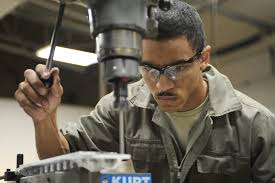
Recruiting efforts can also be bolstered by making things easier for a potential applicant. This includes displaying career opportunities and employee benefits prominently on the company’s home page and making the application process easy and convenient. Jasper Rubber, an employee owned rubber contract manufacturer in Indiana, is a great example of a company that has made this a priority. The homepage of the company’s website includes front and center a large link to the “career opportunities” page under a banner that says “Your Future Begins Here”. This is paired with links highlighting many of the generous benefits offered by the company. Mike Hayden, Executive Vice President of Operations at Jasper Rubber explains, “As an employee owned company, we believe that Jasper Rubber offers many unique opportunities and great benefits. We didn’t want to bury that in a ‘career’ page that is difficult to find.” In addition to emphasizing career opportunities and benefits on its homepage, Jasper Rubber also makes applying for positions easy by accepting applications either onsite or online.
Reconsider the Job Requirements and Focus on Training and Education
One way to increase the pool of potential applicants is to reconsider what types of experience, certification and skills are really necessary. For each position, ask whether the right person could be successful with the right training even if they have little experience. If the answer is yes, focus on hiring someone who is eager and able to learn new skills rather than someone who “checks all the boxes” in terms of experiences, current skills and certifications. A good training program and the opportunity to gain new skills may, in fact, be an incentive that encourages people to join your organization. A 2015 article titled “HR Gets Creative to Hire Manufacturing Workers” by Dori Meinert at the Society for Human Resource Management, highlights EJ Ajax, a metal forming company in Illinois, as an example of a manufacturing company that is leading in hiring and training workers. The company hires workers in partnership with state and county programs aimed at helping the long-term unemployed, single parents, or people that were previously incarcerated. The company emphasizes developing the skills of its employees and prominently posts a skills matrix, which lists the machines and tasks for each department along with each employee’s skill level. This serves as an incentive for both employees and managers to advance training and demonstrates the career paths available to employees.
 Another opportunity to attract and retain skilled labor and enhance training programs is to offer “dual career ladders”. Instead of promoting the best workers to supervisory or managerial roles, provide other incentives for them to opt into a leadership role in their current function. This allows the best workers to continue in their role (where there may be a shortage of workers) and also gives them an opportunity to train and mentor new employees.
Engaging with local trade schools, high schools, community colleges and workforce development programs is another way to increase exposure to potential workers. Seek opportunities to engage with these organizations through guest lectures, plant tours, apprenticeships, and scholarships. Not only will this allow you to develop relationships with potential employees, but building relationships with the organizations that are training the future workforce is a great way to influence what is being taught. If there are gaps in specific skills or knowledge needed for your industry, work with these organizations to see if there are opportunities to adjust their curricula to ensure that graduates of their programs are better prepared for your industry. GenMet, a metal fabrication company in Mequon, Wisconsin, is also identified in Meinert’s article as a company that regularly brings local students in for plant tours, and hosts two-week apprenticeship programs to train high school students. They also take a creative approach in seeking to hire teachers in summer months so that the teachers can share information about the experience with their students.
Invest in a Great Company Profile and Great Job Description
Once created, a company profile can be reused many times in both job postings and social media, so it’s worth it to invest time in creating something that stands out and highlights the best aspects of your company. Focusing on a positive culture and lifestyle balance may be especially effective at convincing people to choose your company. If your company has a positive culture, a short video highlighting this may be a more effective means to promote it than a written description. A video affords the opportunity for current employees to speak genuinely about why they like their jobs and the company.
While the profile can be reused over and over, the job description will need to be tailored for each position. As mentioned before, it is critical to think carefully about what types of skill, certifications and training are really required and what could be taught to the right candidate. Once a firm has completed this process it is critical to accurately and clearly define the requirements in the description. Failing to do so will waste the time of both the hiring company and the applicants as it will increase the number of unqualified candidates that apply.
Consider Outside Help
While the suggestions above can help attract and retain skilled labor, they all require considerable time and effort. Contracting with a recruiting agency may offer an opportunity to more easily connect with the right candidates. However, careful consideration should be put into deciding whether to use a recruiting agency. Good recruiting agencies can save you time by tapping into their extensive networks, but a bad recruiting agency can damage your company’s reputation and do more harm than good. If electing to go with a recruiting agency, it may be best to get a referral from a trusted source within your industry.
————————————————————————————-
[i] 2019 National Manufacturing Outlook and Insights. Leading Edge Alliance, leaglobal.com/assets/page_pdfs/2019NationalManufacturingOutlookandInsights.pdf.
Indiana Manufacturing Jobs

Indiana is the most manufacturing-intensive state in the United States in terms of jobs per capita. However, like most U.S. states, it has not been immune from loss of manufacturing jobs. Many people attribute the loss of jobs to either offshoring or automation, but which is it?
To help answer this question, you may want to read a recent paper written by Timothy Slaper of the Indiana Business Research Center, Kelley School of Business, Indiana University. It is titled: “Automation and Offshoring in Durable Goods Manufacturing: An Indiana Case Study“. The full paper is currently available with a subscription/fee, but Dr. Slaper did write a publicly available preview (see the end of this blog for the links to both the preview and full paper).
It’s about Offshoring
President Barack Obama tours Allison Transmission in Indianapolis
Slaper ultimately concludes that offshoring was the primary driver for the loss of durable goods manufacturing jobs in Indiana, not automation. A few interesting items from the preview –
- Nationally, the “boom” in robotics investment did not begin until after 2014 (and the impact of automation may not have hit yet).
- Slater argues that offshoring – aka foreign imports – rather than nearshoring (the movement of production from one state to another) is the dynamic responsible for Indiana’s job loss.
- The article cites a table of job creation abroad resulting from foreign direct investment (FDI) by Indiana companies. From 2010-2016, FDI announced by Indiana-based companies was slated to created 5,380 jobs in China, 3,892 in India, and 3,715 in South Korea (the top 3 countries).
- According to some economic theory, the productivity and wages of workers remaining after a layoff should both increase. (Slater investigates this phenomenon in his study and finds that it appears to have held true in Indiana for his dataset.)
Dr. Slater’s full paper examines 38 durable goods industries in Indiana from 1998-2016 for which the data needed were available. He found that offshoring was potentially responsible for job declines in 19 of these industries, while automation was a potential cause in just 5 (including 3 also included in the offshoring number).
From this he concludes offshoring to be the primary cause of manufacturing job loss in Indiana’s durable goods sector over the past 2 decades. Importantly, Slater only looks at intermediate goods (i.e. material inputs, not final products) as a source of job loss in his analysis – what he calls “Type 2” offshoring. These inputs are precisely the kind of parts and components made by most small and mid-sized manufacturers.
Slater is careful to point out that his analysis is not definitive, but that it is consistent with many other national studies, especially those by Susan Helper at Case Western Reserve University. Those of a mathematical bend might want to review Dr. Slater’s study – see the link below. (He utilizes an OLS regression analysis. His empirical model is interesting, though!)

Assistance for Import Impacted Manufacturers
The Great Lakes Trade Adjustment Assistance Center (GLTAAC) tracks trends in U.S. imports in support of our outreach efforts to identify import impacted manufacturers in Indiana, Ohio and Michigan who may be eligible to qualify for $75,000 in matching funds to execute business improvement projects to enhance competitiveness.
Click here to determine if you qualify
Contact us to quickly find out how we can help your firm.
Phone: (734) 998-6227
Email: gltaac@umich.edu
Article Links:
Dr. Slater’s preview article: “Automation and Offshoring in Durable Goods Manufacturing: An Indiana Case Study“.
Full paper in Economic Development Quarterly: Click here to link to the Abstract page. Note that download of the fully paper requires a subscription/fee.
Good Times for Small Manufacturers – But Dangerous Too
Manufacturing Imports Continue at All-Time High
Times are still good for small manufacturers. Demand is strong and most companies are busy. If a small manufacturer isn’t making money in this environment, something is wrong.
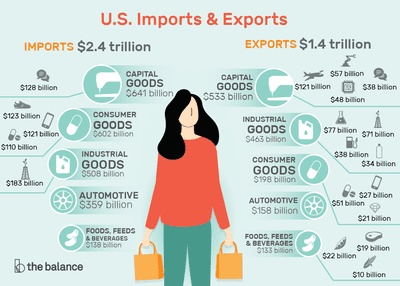
At the same time, it’s important to know that manufacturing imports are at an all-time high. For the year ending 10/31/2018, the value of manufactured goods imported into the U.S. was $2.2 trillion (the highest 12-month value ever recorded). It also marked the highest annual growth rate (9.9%) since early 2012.
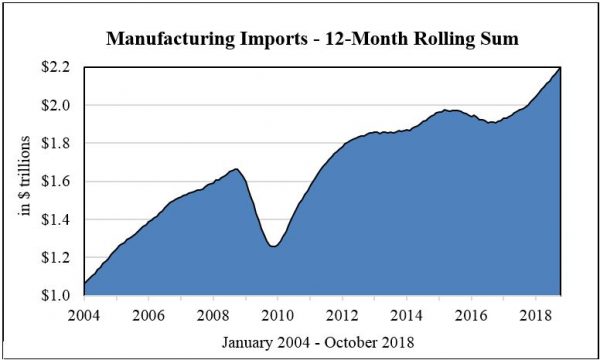
How could this be, you might ask. Well, the hot U.S. economy is driving demand, there is little open capacity in most of the domestic manufacturing sector, and the Dollar is strong. So imports are relatively cheap and purchasers need to buy more inputs.
This creates a dangerous situation for small manufacturers. In such an environment, sometimes you simply can’t supply all of the parts your customers want when they want them – you don’t have the people, and/or you don’t have the capacity.
Some customers may well turn to a foreign supplier for the additional parts they need. Really, what choice do they have? This means new low-cost competition, where even a long-time customer could potentially re-source all of your parts. At any time. If not this week, next month or next year – whenever the economy slows. Or maybe the customer will just make you match his new foreign supplier’s price to keep his business going forward. That’s all.
Times are still good. But as soon as demand weakens, there will be consolidation. Switching will occur. And much of this will be to foreign suppliers. (Of course, this is already happening to some small manufacturers in the region. But we ain’t seen nothin’ yet.) Dangerous times, indeed.

No Such Thing as a “Lean Job Shop”
As I visit companies in Ohio, Indiana and Michigan, I consistently hear that lean manufacturing does not work in job shops. The belief is that lean manufacturing only works in low mix/high volume environments, e.g. Toyota, but not in the high mix/low volume environments typified by most job shops. In other words, there is no such thing as a lean job shop. After all, if Toyota is the world-class example of lean, that should be proof enough!
This belief is completely understandable but operationally incorrect. Lean manufacturing is equally applicable in small job shops just as it is in large repetitive operations.
To understand why this is so, it is important to remember the purpose of lean manufacturing, i.e. reducing or eliminating process steps that do not add value in the eyes of the customer. Therefore, it does not matter what the size or type of shop is it only matters what steps are being performed that the customer does not value.
Years ago, I heard a definition of value from the customer’s perspective that has stuck with me. Value is those process steps that physically change the product and that the customers are willing to pay for. When a part is being machined, the part is changed physically and the customer is willing to pay for that. However, when the feedstock is being loaded into the machine, the part is not changing and the customer doesn’t want to pay for that operation. It is understood that not all processes that do not add value ‘in the eyes of the customer’ can be eliminated of course, but it does not negate the need to reduce or eliminate as many of them as possible.
The application of lean in a job shop is different than the application in the low mix/high volume operation. Figure I shows 20 tools which can be used in a lean implementation. It is not required that all of them be used, instead think of these as the tool box from which you use the most appropriate tool. But notice, regardless of the tool(s) chosen, they all lead to continuous improvement focused on the customer.
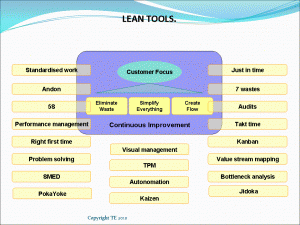 Figure 1 (copyright TE 2010)
5S is an example of a lean tool that applies in any size shop. The 5S’s are Sort, Set, Shine, Standardize and Sustain. 5S is all about getting organized and staying organized.
SMED (Single Minute Exchange of Dies) is another tool that most organizations can use regardless of size. SMED is all about reducing change over time. The shorter runs that are the nature of job shops clearly would benefit from finding ways to reduce setup times between jobs.
Recognizing that job shops can benefit as much from lean as any other enterprise, Dr. Shahrukh Irani, President of Lean + Flexible LLC, makes the following observation:
“The Principles of Lean“ as described by the Lean Learning Institute are universally applicable in any manufacturing sector. To this day, job shops often implement lean taking a cookie-cutter approach based on the Toyota Production System (TPS). While some gains are realized, a better approach is JobShopLean. JobshopLean implements the Principles of Lean as follows: (1) Identify the product families, (2) Design a Hybrid Cellular Layout for the facility that fits the overall material flow implicit to their product mix and (3) Schedule daily operations using Finite Capacity Scheduling software (instead of relying on their ERP system).”
If you would like to learn more about taking advantage of lean manufacturing in your business, please contact the Great Lakes Trade Adjustment Assistance Center, www.gltaac.org.
The Great Lakes Trade Adjustment Assistance Center (GLTAAC) is a federally funded, non-profit organization that provides business assistance to manufacturers that have been directly hurt by imports. We bring the TAAF program to firms in Ohio, Indiana and Michigan.
Why Should I Care About Lean Manufacturing? It Doesn’t Apply to my Business.
It’s hard to believe in this day and age how many businesses still choose not to take advantage of the benefits of adopting a Lean culture.
As a business owner or officer, you are free, of course, to make a decision not to implement Lean – after all it’s your company. Maybe you’re already making more money than you can count, customers can only buy from you, and your workforce is engaged and stable. If that’s the case, you can surely ignore Lean. On the other hand, if that isn’t your company, not implementing Lean can leave you with a competitive disadvantage. While you sit still, your competitors are moving forward, always seeking new ways to eat your lunch.
What is Lean? In a nutshell it is a mindset to maximize customer value while minimizing wastes. It’s a mindset, not a one & done event. It is always being mindful of sources of waste that are taking away from increasing value delivery to the customer.
Most people have heard of Lean Manufacturing but Lean applies to many other areas within the business. There are disciplines of Lean Design, Lean Accounting, Lean Supply Chain, and Lean Construction to name a few. While they are functionally specific to their respective areas, they are all common in the relentless pursuit of wastes elimination.
What Wastes? There are 8, identified by the acronym DOWNTIME: Defects, Overproduction, Waiting, Non-utilized talent, Transportation, Inventory, Motion, Extra-processing. A brief explanation of each may be helpful.
Defects – a part or process that doesn’t meet customer expectations. If you rework it, you incur the cost twice.
Overproduction – making or doing more than is needed. If you can’t ship it, you build inventory and tie up cash.
Waiting – time spent waiting for the next step in the process. Increases required floor space, increasing rent and utility costs.
Non-utilized talent – not fully using people’s skills, talents or knowledge. Increased risk of employee turnover results in recurring training costs.
Transportation – unnecessary movement of products and materials. This cost adds no value to the customer, and the customer doesn’t want to pay for this.
Inventory – excess materials not being processed. Ties up cash.
Motion – unnecessary movement of people. Cost that is not adding customer value.
Extra-processing – more work than is required to meet expectations. And again, cost not adding customer value and the customer doesn’t want to pay for this.
Every business has some of these wastes. The ability to see, reduce or eliminate them is a learnable skill. Each area of improvement can deliver additional value to your customers, e.g. shorter lead times, lower price (if you choose), and lower customer inventories (positively impacts their cash flow).
Your business also benefits in multiple ways, e.g. lower inventories (frees your cash flow), reduced costs, improved margins, happy customers, and an engaged workforce.
Progressive companies have embraced Lean to help their business grow. Like Quality systems, Lean is no longer an option if you want to remain competitive.
In a future blog I will talk about Lean Design. This discipline may hold the potential for your company to develop a truly unique competitive advantage.
GLTAAC clients often use their TAAF matching funds to implement Lean practices. You can find some success stories here:
- Yoder Lumber – increased capacity due to improved efficiencies
- Bay Motor – embraced Lean for production and the front office
- Champion Bus – where Lean increased productivity and employee involvement
If you want to learn more about implementing a Lean discipline, please feel free to contact the Great Lakes Trade Adjustment Center or visit the web site at www.gltacc.org.
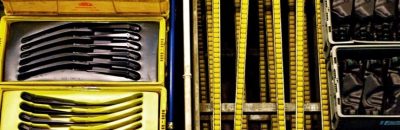
Everything in its place – sorting is part of 5S, a Lean manufacturing tool. (Image: “Ford Rouge Factory Tour” by Nicole Yeary is licensed under CC BY 2.0 / cropped from the original.)
Suggested readings:
Lean Thinking, James Womack
The Goal, Eliyahu Goldratt
All I Need to Know About Manufacturing I Learned in Joe’s Garage, William Miller
2 Second Lean, Paul Akers

Forecast for Michigan’s Economy– As Presented at the 64th Annual Conference on the Economic Outlook
For the state of Michigan, 2016 was the seventh consecutive year of job growth – after a decade of jobs decline. Michigan’s total employment was 4.59 million at the end of September 2016. Even so, total employment in the state has still not quite returned to its peak of 4.9 million in the spring of 2000.
At the annual Economic Outlook Conference held at the University of Michigan in November, presenters forecasted at least two more years of modest job growth for the state (about 1.1% growth each year).
There is still a very tight correlation between the domestic auto industry and the performance of the Michigan economy. The economists forecast total auto sales to essentially remain at current levels for the next two years, and the Detroit Three’s market share to also essentially remain flat over the same period.
However, Michigan’s economy has seen some success in diversifying its job growth away from the manufacturing sector, especially in the highly skilled professional, scientific, and technical services areas, helping to fuel the expectations for modest job gains.
The report forecasts that Michigan’s unemployment rate will hold steady at its 2016 level of 4.6% for 2017 and 2018. This is lower than the national unemployment rate of 4.9% and is a big improvement over the state’s 5.4% rate in 2015.
The conference took place on November 17-18, 2016 – just ten days after the presidential election. While there is uncertainty about the direction of economic policies of the incoming administration, presenter George Fulton indicated the forecast should hold as long as the new administration does not start a trade war. “It is imperative to be clear that a full-blown trade war would be a disaster for the Michigan economy,” said Dr. Fulton, Director of RSQE (Research Seminar in Quantitative Economics) at the University of Michigan and head of the research effort.
He went on to say that he expects much of the campaign rhetoric regarding trade to be overblown, with mostly symbolic actions taking place. GLTAAC agrees, and believes the new administration is unlikely to implement policies that will precipitate a huge contraction in trade.
Highlights of the original study can be found on RSQE’s Michigan Forecast website.

Trade Deficit Highest Ever in 2015
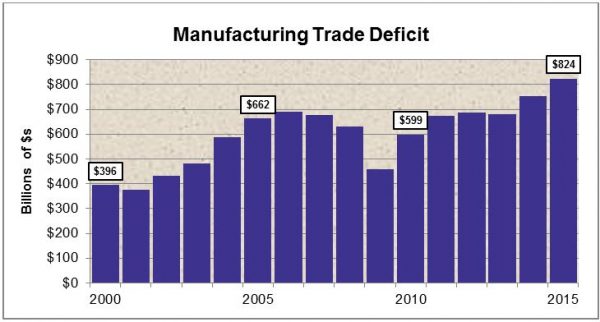
Full-year trade data have been posted – no increase in manufacturing imports, but exports down, and the 2015 trade deficit in manufactures was the highest ever.
Due to a weak 4th quarter, total manufacturing imports finished 2015 slightly below 2014’s level (-0.62%). Imports of manufactured goods reached $1.940 trillion last year, compared to $1.952 trillion in 2014. Imports from China, Mexico, and Korea were up for the year as a whole, while those from Canada, Japan, and Germany were down. China was responsible for 24.0% of manufacturing imports in 2015, followed by Mexico (13.4%) and Canada (10.8%). 2015 was the second highest year ever for manufacturing imports (behind only 2014). 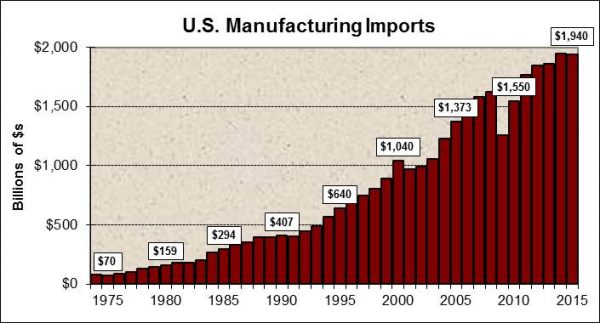
A strong dollar and weak foreign markets caused U.S. manufacturing exports to fall by 6.2% in 2015, to $1.116 trillion. (This was their lowest level since 2011 – $1.103 trillion.)
As a result, the U.S.’s trade deficit in manufactured items hit another record last year. Our manufacturing trade deficit increased from $754 billion to $824 billion in 2015. The U.S. had a negative trade balance with all 6 of our major partners, and the deficit increased for our big 3 – China, Mexico, and Canada.
All info from USITC DataWeb. Imports = imports for consumption. Exports = domestic exports. Data in current dollars.
How TAAF Works (And Yes, U.S. Manufacturing Still Needs it)
Here at the Great Lakes TAAC, we keep a close eye on how imports are affecting U.S. manufacturing. As I’ve written in previous blog posts, the import threat is not going 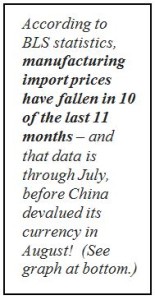 away. The low cost of imports is just getting lower. That means a continued uphill battle for many manufacturers, especially the small and mid-sized companies that we work with.
We’d like to thank the Michigan Manufacturers’ Association for an article it recently published about how the TAAF program works. While our website provides in-depth information about the program (please have a look around!), this article ties everything together in a single document.
You can download a pdf of the MMA article by clicking here, or check it out in the July 2015 special issue of MiMfg.
Please feel free to share the article with any manufacturers in Indiana, Michigan, or Ohio who have been hit by foreign competition (maybe that’s you). GLTAAC is here to help them improve their businesses so they can better compete in today’s challenging global economy.
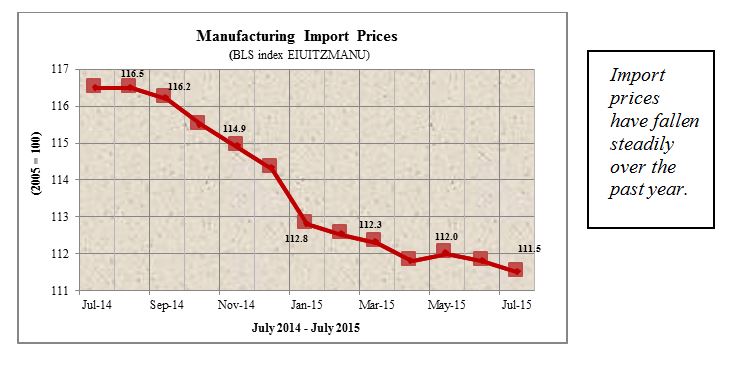 Now that you know more about how TAAF works, have a look at my post Why TAAF Works.

Additive Manufacturing Brings Hype and Great Potential
Of the technological innovations transforming manufacturing, additive manufacturing may be the most discussed. Publications from technical industry magazines to Harvard Business Review have discussed its potential, and called out its hype. The Great Lakes TAAC is hearing more about additive manufacturing from our firms, and it’s a technology whose impact more small manufacturers should consider.
Additive manufacturing (AM) has been in use for over 25 years and is known by many as 3D printing, a term that is essentially synonymous. Stereolithography equipment would chug out small prototypes at design firms. With advances in computing power, more specialty materials, and the expiration of patents, the technology has come down in cost. This has spawned a home hobbyist market, which drives much of the media attention. But the real potential still remains in design and manufacturing.
A field trip

Small machines available for projects at the library
Earlier this summer, fellow GLTAAC project manager, John Antos, and I paid a quick visit to the 3D printing lab on the engineering campus at the University of Michigan, five minutes from our office. Basic 3D printing is so accessible that a set of four small printers, capable of producing small pieces, can be checked out by students after watching a brief online tutorial. The machines are part of the library.
That’s a long way from industrial scale operations, but it shows how ubiquitous the machines have become. Larger machines are also available for more sophisticated work. Parts from class projects or graduate level designs keep the machines running constantly. Many projects are in collaboration with a medical specialty, where a custom piece for a patient is explored. A staff is available to schedule machine time and help engineers or student teams tackle more comlex needs.
AM technology
AM encompasses many processes where a part is made by building up material layer by layer. Early processes included stereolithography, where melted resin would cure with directed UV laser light. Other techniques, such as extrusion and sintering, have been applied in additive fashion, using a digital 3D file and machine guided application of material to each layer.

Larger machines are in demand for advanced projects
Most industrial use thus far has been with plastics, though industrial scale machines can also work with metal alloys, melting a metal powder as layers are built up. Since material is built up, the machine does not require tooling, saving significant up front cost. Design iterations can be run economically, creating great flexibility for designers testing out ideas. Additionally, the process does not create nearly as much scrap as traditional manufacturing methods. However, these savings are offset by much higher material cost and slower processing speeds. The machine itself is also a significant up front cost. Researchers have evaluated the economics of AM versus injection molding and other processes. Hard and fast rules are not clear as geometry, volume and other factors affect each job. Though large volume jobs are clearly more economical with traditional methods. Engineers also need to consider whether parts built layer-by-layer will have the same durability as parts created by injection molding or casting.
Of added significance is AM’s ability to produce parts with geometries not possible with traditional manufacturing. Components that may have required assembly might now be printed as one piece, saving costs in assembly or welding.
Designing pieces with lighter weight is also possible. A very well-known use of AM comes from GE Aviation, which is using a special metal alloy to produce small nozzles for jet engines. An industry researcher points out that the economic benefit is in the weight of the piece (saving jet fuel cost), not material saving or lower manufacturing cost. (The Limits of 3D Printing, Matthias Holweg, Harvard Business Review, June 23, 2015)
Matching capabilities to strategies
How should small manufacturers approach AM? The equipment is a significant investment. And, regardless of AM’s impressive capabilities, most experts in the field don’t expect to see AM replacing injection molding or casting in much of manufacturing. It seems to be viewed as an evolving strategic tool, a mainstay of product development, and a potential production option for short runs and highly customized jobs.
Regardless, a 2014 Gartner report estimated that worldwide end-user spending on 3D printers would jump from $1.6 billion to $13.4 billion from 2015 to 2018. When is the last time a machine realized that kind of growth? To consider the impact of AM on your business, the following questions are worth considering.
Sales
- Do your customers expect assistance with prototyping or design for better manufacturability?
- When pursuing new business with customers, is your firm a resource regarding manufacturability as a project moves forward?
- How important is it for your business to be involved at the early prototyping stage of a project to land the eventual job?
- Do you have the know-how to help a customer determine which production approach is most economical?
- Can you help a customer launch at low volumes, then transition to higher volumes, offering cost effective approaches at each step?
- Do you have the design and engineering capabilities to attend to all these needs?
Product Development
- How many ideas have you considered testing, but product development was just too expensive?
- How quickly can you test out a new idea in the market?
- Will AM-specific materials meet needed structural requirements?
Firm Capabilities
- Do you have multidisciplinary team members who are trained in this technology?
- Are you able to accept electronic files from your customers?
- Can you convert a CAD file to a file capable of guiding the three dimensional work of 3D printers?
- Would offering this service set you apart from competitors?
Evolving and advancing tech
To test the waters with AM, it may not be necessary to invest in a printer. There are many established 3D printing service bureaus that will accept designs and deliver parts. Even UPS has ventured into 3D printing, offering printing services at its stores. UPS even targets manufacturers needing jigs and fixtures, recognizing these pieces as short run and time sensitive, ideal for AM. A readiness to field AM needs with a well-versed partner can help bolster a firm’s overall value to its customers.
In the near-term, AM may find its way into more shops via hybrid machines that offer traditional machining processes alongside an AM tool. Parts could be cut and shaped in one stage with a metal or plastic layer added via a specialized tool.
But AM technology continues to develop in ways that may surprise. Google Ventures recently invested $100 million in Carbon 3D, a company that has developed technology (via research at the University of North Carolina) that builds up parts from a liquid bath at rates much faster than existing AM. The process, called Continuous Liquid Interface Production, forms the part out of a liquid using photochemistry techniques. The company claims its technology can “print” in minutes plastic pieces that take hours via traditional 3D printing. It also eliminates layers, potentially producing parts with properties similar to injection molded pieces.
Better, faster and, possibly, cheaper options may be on the horizon. Learning to work with AM, either in house or with a partner, will be a worthwhile investment.

Why TAAF Works
The Trade Adjustment Assistance for Firms program (TAAF), which we run here in Michigan, Ohio, and Indiana, is successful for many reasons. Numerous studies and evaluations of TAAF have been done over the years. These have consistently found the program to be effective and efficient – but none of them have ever fully identified why it works.
The TAAF program works well because the business assistance model it uses is strong. And what makes it strong? I’m glad you asked.
The key components of the TAAF service model responsible for driving the program’s success are discussed below.
Success Drivers

- Client company management team dedicated to long-term success. Firms that aren’t serious about rebuilding their business simply don’t use our program. We ultimately help small manufacturers invest in themselves, strengthening their capabilities more efficiently and effectively than they could without our assistance. This requires a substantial commitment of time, effort, and money from companies and their leaders. So TAAF isn’t a good match for firms that aren’t clearly committed to the future.
- Flexibility. There is great flexibility in (a) the projects firms can undertake through the program and (b) the service providers that can be used. (service providers = consultants, engineers, trainers, and other outside expertise.) The first enables clients to implement whatever improvements they need through the program, be they in sales, marketing, production, quality, finance, accounting, management, or something else. It also means projects can be highly targeted, focused only on precisely what is needed, which yields high impact, low cost projects. Regarding b, flexibility in the consultants used means client companies can always get the best fit possible for each and every TAAF project they do.
- Up-front planning. Before undertaking any projects, GLTAAC guides firms through a planning process to develop an Adjustment Plan (which is a recovery plan designed to help them “adjust” to the import competition they face). This enables firms to codify and prioritize changes that must be made to improve their overall competitiveness. Importantly, this process identifies which improvements the company can do internally, using their own personnel (independent of the program), and which ones they need outside expertise to accomplish (utilizing TAAF co-funding).
- Unbiased assistance. Because GLTAAC staff don’t do the actual project implementations, we have no incentive to advocate for any particular course of action (during the planning process) or to promote any specific service provider (for projects). We are uniquely positioned to be neutral in our perspective. This leads to a customized recovery plan, and the best provider for each project.
- Strong professional staff. GLTAAC is staffed by business professionals, not academics or government employees. Our Project Managers all have substantial manufacturing experience (an average 15 years each), in a variety of positions. So we understand the challenges small manufacturing firms face.
- Partnership relationship. Still, we know we will never understand a company as well as the firm’s management team does. And that’s just fine. TAAF functions as a partnership, with the firm bringing their knowledge of the business to the relationship, and GLTAAC providing a fresh set of eyes, plus the experience of working with hundreds of other manufacturers that have similarly been hurt by imports. Importantly, GLTAAC also has expertise successfully working with consultants (on all sorts of business improvement projects), and structuring these projects to deliver real results.
- Cost-sharing. Client companies must pay part of the cost of all services provided to them (typically 25% of the planning and 50% of project implementations). This has 2 important effects. First, it ensures that only firms committed to recovery participate in the program; and second, it stretches program resources for all companies. (That firms pay for 50% of the consultant costs for their projects obviously increases the volume of projects GLTAAC can do. Further, however, all client payments collected for Adjustment Plan development are earmarked to fund additional client projects.)
- Long-term engagements. To qualify for TAAF, firms must be losing sales and employees (as well as losing business to imports), so all of the small manufacturers we work with are challenged, and many are seriously distressed. Trade-injured firms have significant issues and usually must make considerable changes to their business. This takes time. And the TAAF program provides that time. Most companies are in the program for 4-6 years or more. For example, so far in 2015, 10 GLTAAC clients have completed the program – they did an average of 5.1 projects in 5.7 years.
What does Success Look Like?
Ultimately, the answer to that is simple – improved client company performance. Each year we collect info on all of our established current clients and recent program grads. We particularly look at firm survival, profitability, sales, and employment. Here’s what the data show.
- High firm survival rate. 96% of all of the companies we’ve worked with over the past 5 years are still in business. (This is particularly impressive given their condition before starting the TAAF program – only half were making a profit from operations, they had lost an average of 15% of their sales in just the prior year, and they’d been forced to lay off an average of 18% of their employees during the past 12 months.)
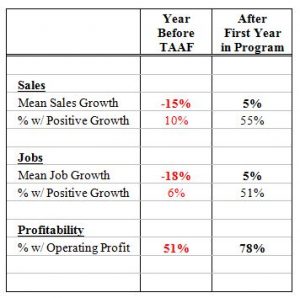
- Immediate improvement. After their first year in the program, the 75 companies included in our 2015 survey had averaged a 5% increase in both sales and employment (regardless of the calendar year). Furthermore, the number generating a profit from operations jumped from 51% to 78%. (See chart to right.)
- Sustained performance. Company growth over time has been strong. These firms have averaged a 4.3% increase in sales per year since starting TAAF, and a 3.5% CAGR in employment.
- Broadening impact. By the end of their 5th year in the program, 78% of the 2015 surveyees were rebuilding sales, 70% were adding jobs, and 90% were turning a profit from operations.
The following 2 graphs illustrate the improvement in GLTAAC client performance by program year (iow, by how long they’ve been in the TAAF program), using year-over-year employment changes. (Sales and profitability numbers follow the same trend, though they are a bit more bumpy.) The first graph shows the percentage of firms in GLTAAC’s client base that added jobs each year. And the second one provides their average job growth during that year.
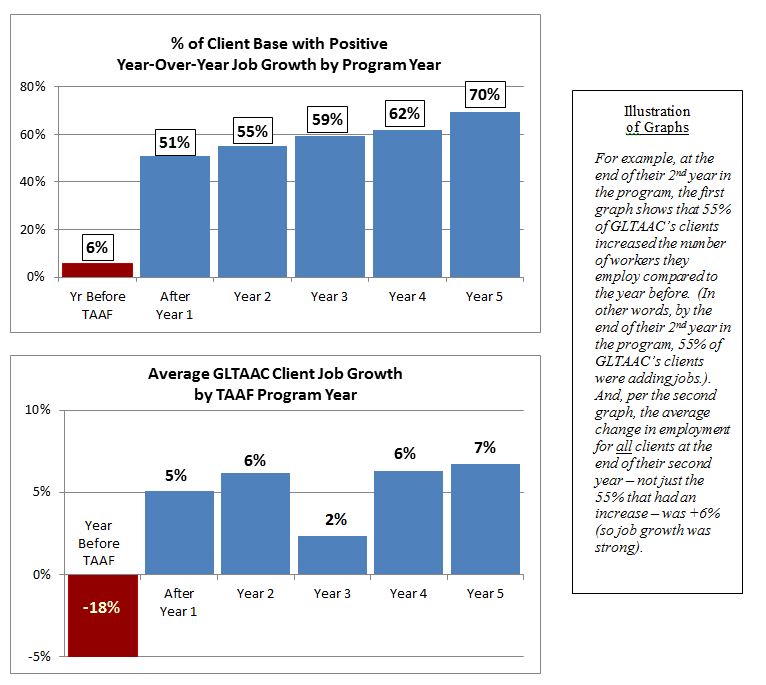
These numbers look good, but it’s hard to evaluate them without some sort of benchmark. So below is a look at job growth by calendar year for GLTAAC’s client base compared to the annual change in total U.S. manufacturing employment. (The U.S. data comes from the Bureau of Labor Statistics – the December over December change in BLS series CES3000000001. The GLTAAC numbers are the current versus prior year change from our annual client performance surveys from 2004 – 2015.)
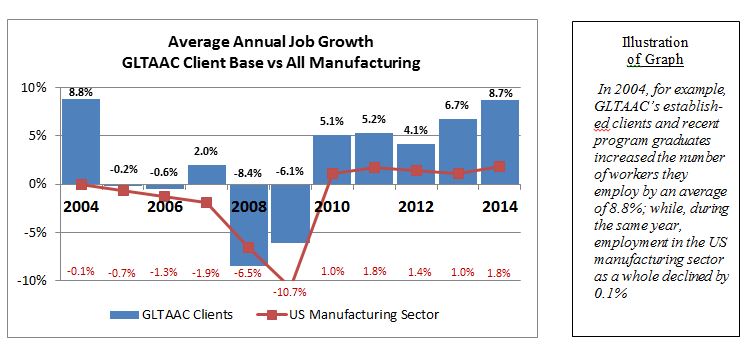
As can be seen, in terms of job growth, GLTAAC’s client base has outperformed the overall manufacturing sector in 10 of the last 11 years (with 2008 being the exception). And in most of those years, the difference was quite large.
The TAAF program works. It works because the program service model is strong. And TAAF’s strength shows in the success of our clients: year after year after year after year.
(Want to know more about how the TAAF program works? Have a look at our web site – including my post How TAAF Works.)

Gender Gap Workforce Solutions- Part 2 in a Series
In my last blog, I introduced the re-emerging topic of women being part of the solution to the talent gap in skilled manufacturing jobs. The concept is far from new, because we know how critical women were from 1940 to 1945 when the term “Rosie the Riveter” was born. A report just released by Deloitte, the Manufacturing Institute and APICS (the supply chain council) measured the number of women in manufacturing at less than 30 percent. Yet women make up 47% of the workforce. Since these are general numbers, the first thing we recommend to our readers is to consider the specifics at your company. Are women representing about 50% of your workforce? Should they be? If your answer is “they should be, but they are not,” you are not alone, and “read on”!
To start addressing lopsidedness in the gender of your workforce, try some focus on three areas: the current recruiting program, the long-time-in-the-future recruiting program, and the workplace environment.
Differently Designed Recruiting Programs
You already know “image matters”. Since recruiting is simply a specialized form of marketing, “image matters” in recruiting, too. The challenge starts with the poor image manufacturing has in general to today’s workers. Add to this the challenge of giving manufacturing an image that is attractive to women workers, and you have just reduced the odds exponentially. The good news is, often it is an image problem more than it is a problem of the actual environment and opportunity.
- Rhonda Matschke, senior vice president of human resources at Generac Power Systems, in Waukesha, WI states the “image” problem this way: “We need to be sure that we are branding manufacturing for what it is today, and not what it has been in the past.”
- The Deloitte University study(1) says: “The image of the manufacturing industry as ‘dirty, dumb, dangerous, and disappearing’ has persisted … today [these companies] are pristine environments housing highly advanced production machines and processes.
- GLTAAC’s blogger, Parker Finn, has also shared ideas for creating apprenticeships and internships that address the “attractiveness” issue of manufacturing.
- So first address the image of manufacturing in general, and then take one step further to hone your image to be attractive to women. For example, go beyond ‘word of mouth.’
- Too many manufacturers, especially small ones, rely on their own workforce, usually all men, to recruit their replacements. A new workforce strategy would focus on learning what prospective female workers want in a manufacturing job. Starting with top management, get out and talk to women who are working in your community and ask them what they value about their workplace. Take notes on the items that your company already offers or could easily add. You’ve just scripted the vocabulary for your next job-posting.
- Next, find out where to place your ads. Today’s on-line strategies enable targeting in more ways than yesterday’s classifieds. Talented women workers may be looking at gardening and on-line photo album sites, more than content related to football and auto-repair.
Start young
Manufacturers will need to start young to “build the talent pipeline.” A ‘workforce forecast’ spreadsheet (like the one described in my last blog) can help, and many manufacturers may see how it makes sense to invest in future sources of talent. One Ohio manufacturer partnered with an educational group in the community to create a Girl Scout program to give young girls a positive experience of manufacturing. It resulted in great headlines like, “Can you Weld Like an Eight-Year-Old Girl?”
A consulting group based in metro Cincinnati created the “America’s Manufacturing Crisis” infographic shown here and displays it repeatedly on websites and on banners to heighten awareness of the importance of developing tomorrow’s manufacturing leaders.
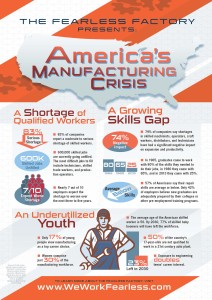
Another great example comes from Jackson, Michigan and the Jackson Area Manufacturers Association (JAMA) which has a long-running Academy for Manufacturing Careers. Their 2015 line-up up youth programs includes “Girl M-Powered”, a week-long summer camp for girls in grades K – 6. By learning to weld and run a CNC machine, girls gain confidence in science and math skills, develop leadership skills and improve their critical thinking and problem solving techniques.
Create a Welcoming Workplace Environment
The 2015 “Women in Manufacturing Study” by Deloitte, APICS (the supply chain council) and the Manufacturing Institute gives us a general list of what motivates women to join and stay in a manufacturing facility. They found the most “impactful programs their organizations offer” are: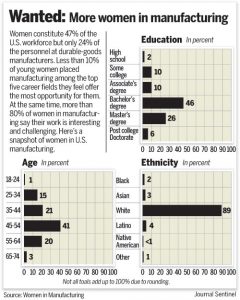
- Flexible work practices
- Formal and informal mentorship and sponsorship programs
- Improved visibility of key leaders who serve as role models.
- The first one on this list, flexibility, is fortunately becoming more commonplace. Even WalMart has announced flexibility in scheduling as part of their newest corporate social responsibility program. They have installed new software that enables more workers to enter and obtain preferred schedules, without compromising a supervisor’s ability to make sure a shift is covered.
- A blog in GE’s “Idea Lab” blog highlights the next two points. The author, Jennifer McNelly, President of The Manufacturing Institute, suggests sponsorship programs and actively working to break leadership stereotypes are important best practices for retaining female talent. She says, “…a sponsor is a mentor, a coach and a vocal advocate for a [woman employee] who can assist with that person’s professional development.”
At GLTAAC we recognize that recruiting and retaining women is only going to be part of the talent gap solution. But it may be a relatively easy solution that many small and medium-sized manufacturers may be ignoring. After all, business leaders today were not around in 1945 when Rosie the Riveter was the main welder on the production line.
(1)Deloitte University, Help wanted: American manufacturing competitiveness and the looming skills gap , Deloitte Review Issue 16
Women, Welding and What 21st Century Manufacturers May Need to Relearn – Part 1
Soo…. You’re having trouble finding talent for your production floor? Are you tapping and searching the entire workforce, or only half? Some manufacturers are successfully solving their talent gap problem by recruiting women. Stories of women on the production floor in manufacturing are cropping up and they are fascinating. In October 2014, The Milwaukee Journal Sentinel(1) highlighted stories about four women: a machinist at the Harley-Davidson Inc. plant in Menomonee Falls, WI, a machinist and product development specialist for medical equipment at Phillips-Medisize Corp in Hudson, MN, a wire harness line worker at Generac in Whitewater, MN and a welder at Northstar Aerospace in Duluth, MN.
Aleasha Hladilek has been a welder at Northstar Aerospace and a welding instructor at Wisconsin Indianhead Technical College. Photo Credit: Wisconsin Indianhead Technical College
Is a gender gap really a problem?
Research shows, however, that examples like those described by the Milwaukee Journal Sentinel are far too rare, and that the U.S. needs to greatly boost its ability to attract all workers to manufacturing. While women represent nearly half (47 percent) of the total U.S. workforce, they comprise less than a third (27 percent) of manufacturing workers. Meanwhile, 80 percent of manufacturers report there are negative impacts of a skills gap.
To solve our 21st century manufacturing dilemma, improving recruitment and retention of women may the best investment of scarce recruiting dollars, if, indeed, this half of the workforce has simply been ignored — since about 1945. References to “Rosie the Riveter” from the WWII era are coming into vogue again as journalists and artists try to illustrate how the “fabric” of the American workforce is again evolving. In fact, a Long Beach, CA newspaper, The Signal Tribune, featured a photo gallery of women in manufacturing for their 2015 Mother’s Day edition.
Ami Rasmussen of Los Angeles is an interior assembly foreman at the Kinkisharyo railcar factory in Palmdale, California. Photo Credit: Deanne Fitzmaurice
As the results of a study conducted by Deloitte University and the Manufacturing Institute in 2014 show, “one of the [manufacturing] categories forecast to be hardest hit by the talent gap is skilled production workers (machinists, welders, cutters, and solderers). These workers account for 51 percent of manufacturing employment in 2012.”
- Today the skilled production workers category is experiencing the highest demand for skilled workers among all the manufacturing categories in the study.
- To put this in perspective, the number of welders has already fallen from 570,000 in 1988 to fewer than 360,000 in 2012. Today, the average age of a welder in the United States is 55, and he or she is likely to retire within 10 years. Accounting for these retirements and the current talent pipeline, the American Welding Society estimates that, by 2020, there will be a shortage of 290,000 welding professionals. And this is just one segment within skilled production occupations.
These are some statistics. At GLTAAC we’d like to know how it looks in your company. Are less than one third of the employees on your production floor women? And if they are so few, is it a problem? If business is going great, maybe it is not a problem. In case it is an issue for your firm, this blog offers a mix of solutions from our own GLTAAC experiences, and solutions we have heard across our three states: Michigan, Indiana and Ohio.
Solutions to Fill the Talent Gap
Start with a forecast of your company’s talent gap. The Deloitte study suggests manufacturers “manage the talent pipeline like a supply chain.” In supply chain planning, forecasts help companies plan make the right investments up front, so that fewer crisis and show-stopping emergencies hit their production floor. In other words, use agile and data-driven analytical planning to forecast talent shortages, and make investments to build resilience and flexibility. To create a talent forecast, calculate your company’s requirement for welding, machining and soldering talent, and line it up against numbers for likely retirements and expected lead times required to find, hire and train new talent. If a talent shortage is clear, figure out how many sales dollars are at risk, and that will help you estimate the investments your company can realistically make to minimize and reduce the gap.
Deloitte’s most recent study points to the fact that there is a business case for recruiting women and the shockingly low numbers of women in manufacturing today (< 30%) make it the easy target for recruitment that firms cannot ignore.
If you determine you cannot continue to ignore the “other half” of the workforce, stay tuned for several ideas of ways to invest in attracting and retaining women.
In my next blog post, “Gender Gap Workforce Solutions – Part 2,” I discuss recruiting differently, starting young, and creating a welcoming workplace.
——-
(1) Milwaukee Journal Sentinel, October 19, 2014,accessed 5/8/2015
Internships, Apprenticeships And Developing New Workers
Among the most common issues GLTAAC hears from manufacturers is the difficulty of recruiting new workers. The manufacturing workforce is aging, and attracting new workers is an ongoing challenge. To compound the challenge, employers need more highly skilled workers prepared to operate advanced machinery.
The issue has gained a lot of attention. A 2011 study by Deloitte and the Manufacturing Institute notes that 3.5 million manufacturing jobs will need to be filled over the next decade. Due to a lack of skilled workers, 2 million of those jobs could go unfilled.
How did it get to this point? There are many reasons, including the loss of stability and resources that US manufacturers used to offer. Cost constraints in the face of global competition led to plant closures and stagnant wages. There were fewer resources available for development. And the challenges faced by the industry presented a dismal, if inaccurate, view of manufacturing for younger people.
Apprenticeships & Internships: tools to help fill the talent pipeline
Apprenticeships declined significantly in recent decades. An age-old tradition, apprentices would begin hands-on paid work as teenagers and then take on increasing responsibility. Once completing their training, many apprentices would stay on with the firm, providing an ongoing source of skilled and well paid workers. Apprenticeship programs remain strong in Europe. In Switzerland, 70% of young people aged 15-19 are in apprenticeship programs across a range of occupations, from manufacturing to healthcare to banking. Germany, well known for its technical training, can boast 65% of young people in programs.1 The United States, by contrast, has seen a decline in apprenticeship programs. Over the past decade, apprenticeship programs fell by one-third. The U.S. now has fewer than 40% the number of apprentices than Great Britain.2
Yet, some students continue to seek internships to gain knowhow and learn about careers in manufacturing. While not as lengthy and intensive as apprenticeship programs, internships can help students apply classroom study in the workplace. And, in spite of trends, some manufacturers are taking initiative to attract and train new interns. Bay Motor Products, an electric motor manufacturer in Traverse City, Michigan, has tapped a local trade school to invite interns into the company. They hope to recruit some in the future as they graduate and move in to the workforce. Each intern commits eighty hours to their internship over several months. In addition to training potential future workers, the program brings other benefits. Larry Bordine, Engineering Director at Bay Motor, comments that, “You learn by teaching. Explaining work or processes that are second nature forces you to evaluate how you work.” He also offered that interns bring new energy to a group.
Indeed, interns can be a way to help a short-staffed team with extra work. However, interns require a lot of direct supervision. Work tasks need to be well-defined, and should be interesting enough to provide a good learning opportunity. Bordine notes that it’s important to provide substantive work, and that supervision takes time. “They gain some experience and we do get needed projects done. But it’s not a bottom line thing.” Interns have worked on the production floor, mapped processes, and run test equipment. And basic tasks that “need to get done” are part of the mix. Interns will have also learned on the latest software and can bring an up-to-date perspective to an experienced team.
More needs to be done. Interest in manufacturing is lagging among young people, and companies need to apply resources to train and engage new staff. Deloitte estimates the percentage of manufacturing staff dedicated to training has fallen by one half from 2006 to 2013. Internships, renewed apprenticeship programs, and community college involvement are all helping address the issue. A new wave of workforce development and renewed energy in manufacturing may be just gaining steam.
State-based programs – plus workforce development help from GLTAAC
There are a variety of state-level resources for interns. For example, the state of Michigan launched a program to help smaller firms pay for engineering interns from state universities. Read more about this program here: MCRN Small Company Internship Award.
In northeast Ohio, MAGNET and Cleveland State are working together to help employers connect with potential interns. Financial support may also be available. Click here to learn about MAGNET’s internship connection program.
Need more inspiration? Have a look at Ruth Ann Church’s blog detailing how Indiana’s Overton Industries began their own apprenticeship and internship program.
And, GLTAAC can co-fund employee development projects for import-challenged manufacturers in Indiana, Michigan, and Ohio. Our clients use TAAF program matching funds to help in their employee development efforts, including machine training, leadership coaching, and lean systems training
Contact GLTAAC for more information.
1 Can’t Find Skilled Workers? Start an Apprentice Program, Peter Downs, January 17, 2014, The Wall Street Journal
2 Just Whose Job Is It to Train Workers?, Lauren Weber, July 17, 2014, The Wall Street Journal

A New Public-Private Partnership to Benefit Manufacturing: American Lightweight Materials Manufacturing Innovation Institute

Source: ALMMII
Here at the Great Lakes Trade Adjustment Assistance Center (GLTAAC) we believe in the power of public-private partnerships to get things done. A new public-private partnership will be launching soon in Detroit to the benefit of the tri-state region we serve – Michigan, Ohio and Indiana.

ALMII’s mission is to serve US manufacturing by enabling cost effective light-weighting of components for several industries. The institute’s efforts will encompass the entire transportation supply chain, nurturing innovations from conception through design, development and production. While its location at 1400 Rosa Parks Blvd. is not yet open, it is expected to be operational before the end of 2014. Meanwhile workshops and planning sessions are already scheduled and will be held at other locations such as the Detroit Regional Chamber of Commerce.
Why Lightweight Materials?
Ford’s Bold Move with the 2015 F-150

Source: www.ford.com/trucks/f150/2015
- Spot welding is robust. Aluminum requires high precision.
- You can work on dirty steel that has oil on it. Cleanliness is much more important with aluminum.
- Unlike steel, aluminum can splinter when stamped.
- Rather than the single process – spot welding—used on steel, Ford will be using a variety of ways to join aluminum parts together. Baron estimates there may be 10 – 15 different kinds of rivets.
ALMMII Background and Services

Source: ALMMII
The details of the Ford F-150 conversion make it clear that the need for ALMMI is real. Last year, the U.S. Navy issued the solicitation to the competitive bid process under the title of “Lightweight and Modern Metals Manufacturing Innovation.” The Department of Defense award for the ALMMII is $70 million in federal funding to be distributed over five years, and that award will be matched by at least $78 million from the consortium partners. Cost share commitments already announced include $10 million from the Michigan Economic Development Corp (MEDC), $10 million from the state of Ohio and $1 million from the New Economy Initiative, a Detroit-based non-profit.
- Novel metals
- Melt processing
- Powder processing
- Thermo-mechanical processing
- Novel processing
- Coatings
- Joining and assembly
- attracting talent,
- expanding capacity in curriculum for all levels of education, and
- linking education, outreach programs and professional societies to raise awareness of lightweight metals and manufacturing needs.

Source: ALMMII

At Small Manufacturers, the Spark of Change Comes From Many Places
In a nearby coffee shop, there is a tip jar with a sign that reads “If you fear change, put it here”. It’s a humorous reminder that tipping is appreciated, and who wouldn’t rather do without change? In the world of manufacturers, things have changed, of course. The past fifteen years have brought an onslaught of new global competition, advancements in technology, and financial crises. Most people, it would be fair to say, would prefer to part with a few coins during their daily java ritual than embrace change.
What kinds of events trigger a company to change long-held practices? What pushes a firm to embrace something new? That is a sweeping question, but we can share a few common observations. The Great Lakes TAAC has worked with many small and mid-size manufacturers over the past decades, and while each firm is unique, common stories emerge.
Loss of a major customer
Losing a major customer is a difficult wake up call. With many large OEMs taking operations global, long-time local suppliers are often left in unfamiliar territory of having to find new customers with new needs and different purchasing styles. This amplifies existing problems, such as lack of market diversification, limited sales functions, and absent online marketing. The change can often be driven with the help of an outside consultant, whether a market researcher or an ad agency bringing new insights on customer expectations.
Michigan Wheel Marine had to change as the demand for boat propellers shifted to new markets. They were determined to remain world class with their consumer products, but set a strategic goal to diversify into commercial and government markets. They comment, “When we first started working with GLTAAC, our website was dated and did not portray the company as a manufacturer of highly engineered propellers. With their assistance, we have been able to update our website on two separate occasions, staying up-to-date with the latest web practices, and giving us an advantage over our competition which operates primitive websites.” In addition to these projects, the company did additional projects in engineering and marketing with GLTAAC support.
New perspectives
There is sometimes a trigger such as an intense sales seminar or certificate or graduate program. Sharing ideas with peers in a program led by a good teacher/facilitator can reignite a leader’s vision for their business.
Several GLTAAC firms have sent their sales team to training programs. A commitment to training over several months can help reignite the staff and drive new sales. It also fosters conversations about the company’s value proposition and the true needs of their customers.
Big new system
Software for middle market manufacturers has come a long way, and more firms are adopting true ERP systems. This requires great attention to detail, more process mapping and clear responsibilities for collecting and tracking information. And managers are given powerful new tools and insights to manage the business. This fuels more advanced and real time management across the business and creates opportunities for production and marketing.
The Great Lakes TAAC funds ERP selection projects regularly. These are important projects that help answer crucial questions about the firm’s processes and the software systems needed to support the business.
New leadership
A new president with a new perspective can bring great change. Whether from inside or outside the firm, someone new approaching a job has big things in mind. Applying management tools learned at a larger company, or adopting new production methods learned at a more advanced manufacturer could be a great motivator for change.
Often, there is a new generation of leadership. The former owner, possibly the founder or a long-time president, steered the firm to great success during the last boom. They deserve credit. But, sometimes, an established leader can be comfortable with past successes and old practices. We often meet people who are skeptical of online industrial marketing, or they don’t develop employees in a way that matches today’s technical demands. Job descriptions and employee training may be lacking due to work practices going un-assessed for a long time.
All these scenarios, and others, lead to some kind of action. And new leaders and seasoned veterans have embraced and led the charge, like shot of caffeine to the system. It is inspiring for us to work with change agents and dreamers who have a vision to try new things to get back out in front. The Great Lakes TAAC provides support and funding for businesses needing assistance to make their ideas happen.
Is your firm taking steps towards new initiatives? If so, the Great Lakes TAAC could be just the program to help you take that next step!

Neither Imports nor Ashes Can Hold Back Champion Bus
In the past five years, Champion Bus has seen a brilliant turnaround, from being pummeled by imports, the great recession and a devastating fire, to emerging as one of the bus industry’s top performers and most respected brands.
In 2009, the atmosphere at Champion Bus could be described as “tense”, with management in a “determined to survive” mode as a result of the market crash and its effect on the economy. The company was also battling imports from China and Turkey, both of which could offer low cost competition to Champion’s smaller airport-transport busses.
John Resnik had been re-located from a sister bus company in Kansas to lead the Imlay City, Michigan operation. With about 285 employees and typical annual sales of $90 million, he had his work cut out for him. “Almost all of our non-governmental business stopped immediately, so we needed to quickly change our business model and production strategy. Creating a sense of teamwork was going to be job 1, but it was not going to be easy.”
Welcoming assistance from the Great Lakes Trade Adjustment Assistance Center (GLTAAC) was among the “new initiatives” Resnik implemented in 2009. He also recruited help in the human resources area by hiring a GM veteran, Bill Sprague. Next, with the help of GLTAAC co-funding, he launched lean manufacturing projects targeted at improving throughput and increasing employee involvement and understanding of their role in process improvement.
Then, on Sunday, February 14, 2010, a huge fire broke out at night, destroying half of the plant and about 30 work-in-process bus chassis. Fortunately, no one was hurt, but many who saw the fire and the debris thought Imlay City had certainly just lost about 300 jobs. The facility, built in the 1970s, had no sprinkler system or water tower. Water was, in part, pumped from a nearby pond to put out the flames. The building did contain hybrid buses, acetylene, plywood, rubber matting, tires and other combustible materials. Numerous interior explosions could be heard from nearly a mile away while 10 fire departments combined efforts for 17 hours to control the blaze.
The saying, “out of adversity comes opportunity” is particularly appropriate in Champion’s case. A day after the fire, no one would have bet that the company’s next completed bus would be rolling off the line only three weeks later. That is what the team at Champion accomplished, though. The disaster was a catalyst that brought out everyone’s finest efforts to cooperate and work efficiently. By October 2010, production was underway in a completely re-built building.
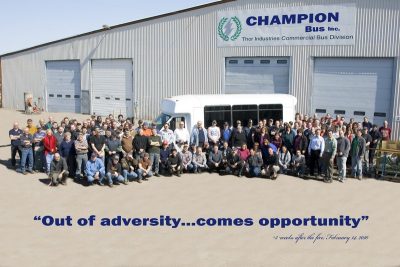
First “post-fire” bus comes off the line, three weeks after the disaster.
GLTAAC co-funding helped the company work on important areas that are not covered by insurance: consulting to streamline the bill of materials process and paying for a “trial period” for a recent graduate to work on marketing. Meanwhile, the company acquired a new product and a new brand, the Federal bus line. Resnik lined up GLTAAC co-funding to help pay for the services of an expert sales representative to help them sell their new product to a new and unfamiliar set of buyers in the industry.
Champion’s new 90,000 sq. ft. facility, completed in Oct. 2010 — with sprinkler systems.
Sales went well, and in 2013, Champion Bus was bought by Allied Specialty Vehicles (ASV) based in Orlando, Florida. ASV has encouraged Champion’s marketing efforts, embracing the initiatives funded by GLTAAC this year to create new websites for both of Champion’s brands (Champion Bus® and Federal Coach®).
The end result is a bus company that is growing faster than its competitors. Since 2009, Champion has steadily increased sales and market share with more growth scheduled. “I used to feel like I was leading Champion in a game of catch-up,” he says. “Today, our revenues are at record-highs, sales are strong and I am personally hoping I can keep up with the speed at which this company is advancing!”
Show Me the Money!
Employee Compensation – Another Illustration of How Manufacturing Drives the Great Lakes Economy
Few people who live outside of Indiana, Michigan, or Ohio understand the vital role manufacturing plays in our region. So I’m constantly looking for ways to demonstrate this fact. Jobs is the statistic most often used, and all 3 states are in the top ten nationally for the highest share of manufacturing jobs in their economies.
According to the Bureau of Labor Statistics (BLS), there are currently about 1.7 million manufacturing jobs in the Great Lakes region (just under 500,000 in Indiana, 560,000 in Michigan, and 670,000 in Ohio). However, 1.7 million is still only about 14% of all jobs in IN-MI-OH, and 14% doesn’t seem like all that much. (Nationwide, manufacturing is responsible for less than 9% of all jobs.)
Jobs in the Great Lakes Region by NAICS Sector
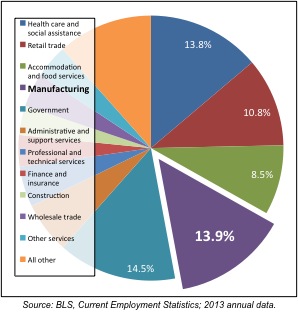 But the number of jobs doesn’t tell the whole story. The quality of those jobs, the pay and benefits they provide, is hugely important. And employee compensation is important not only to those who receive it, but also to the economy as a whole – because (of course) this income is then mostly used to purchase goods and services, and those purchases support other jobs. On the macro level, employee compensation thus captures both the number and quality of jobs in each sector of the economy.
So, per this metric, is manufacturing very important to our regional economy? You betcha!
Employee Compensation by NAICS Sector in the Great Lakes Region
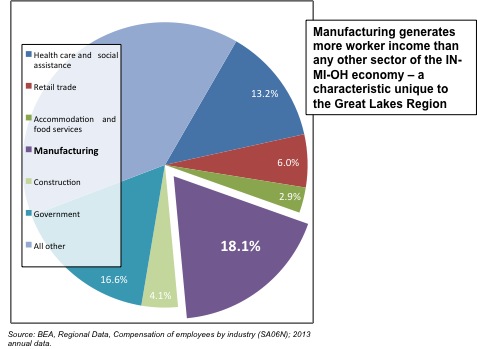
Individually, the manufacturing sectors in Indiana, Michigan, and Ohio rank #1, #3, and #5 among all states in the share of total employee compensation they generate. In sum, Great Lakes’ manufacturers paid out $129 billion to employees in wages and benefits last year.
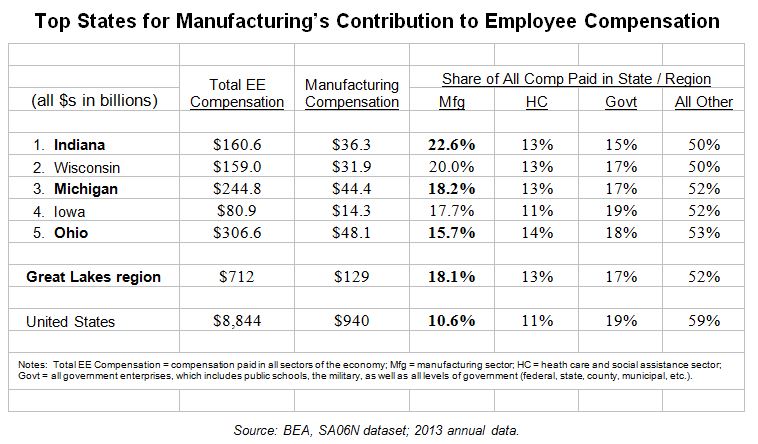
Here’s some context to help put these numbers in perspective: the last time the country as a whole had 18% of employee compensation come from the manufacturing sector was 1990. Remember 1990? The 5 largest U.S. corporations that year were GM, Ford, Exxon, IBM, and GE. (Wal-Mart didn’t make the top 100; Apple was 96th.) Also in 1990, the Dow cracked 2800, the Soviet Union still existed, the World Wide Web had yet to be introduced, and we ran a trade surplus with China. (1990 was also the first season of The Simpsons, which aired on a little-known channel called Fox.) Of course, back in 1990, manufacturing was even more important to the Great Lakes region than it is today. That year, the manufacturing sector was responsible for 29% of all employee compensation.
Although Indiana, Michigan, and Ohio have diversified considerably over the past 25 years, manufacturing still drives the Great Lakes economy.
Bonus factoid! The importance of manufacturing is widespread across the Great Lakes region. A recent report by the Economics and Statistics Administration (of the Commerce Department) offers more granular data than presented above. The Geographic Concentration of Manufacturing Across the United States (ESA Issue Brief #01-13), examined county-level data for 2010. It found that Indiana and Ohio had the most counties where manufacturing accounted for at least 20% of employee earnings: 50 in Indiana, and 48 in Ohio, which is more than half of all counties in each state. Michigan was tied for 10th with 22 counties (27% of all counties in the state). (The full text of this report is available here.)
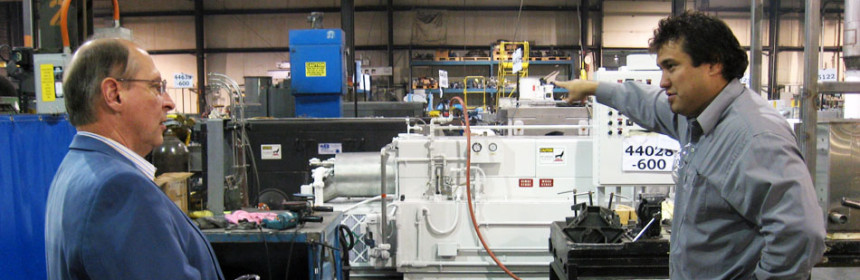
Status and Forecast for Michigan’s Economic Recovery- As Presented at the 61st Annual Conference on the Economic Outlook
Michigan is expected to continue its jobs recovery for at least another two years, making six years in a row of job growth after a decade of jobs decline, said experts at the 61st Annual Conference on the Economic Outlook held on the U-M campus last week.
“Michigan is closing out 2013 with a healthy year of job growth, the second-largest gain in jobs over a year since as far back as 1999, and well in excess of the average yearly gains recorded from 1971 to 2000, prior to the extended downturn of the 2000s”, wrote Joan Crary, George Fulton and Donald Grimes, authors of The Michigan Economic Outlook for 2014-2015. “We are forecasting job growth to continue at a solid pace through 2015”, they said, expecting about 65,000 jobs to be added in 2014 and another 65,000 in 2015. To put this in context, they reported that the 79,600 job additions in 2013, and the 2014-2015 forecasts all exceed the average annual job gains from 1971 to 2000, which were 57,000 annually.
This is definitely good news, but they also pointed out that if one compares Michigan’s progress from the previous employment peak rather than from the most recent trough, “here the news is a little less cheerful”.
From Michigan’s peak employment in the spring of 2000, the state steadily lost a staggering 857,700 jobs until early 2010, when it began to recover. With the job gains already made through mid-2013 added to the author’s forecasts for 2014 and 2015, by the end of 2015 the state will have recovered a little less than half (48%) of the payroll jobs it lost in the 2000-2010 decade.
Michigan’s unemployment stood at 9 percent at the end of 2012, and one would hope that this jobs growth news might lower the state’s unemployment rate, and the authors confirmed this with their unemployment forecast. “We anticipate that the unemployment rate will nudge down to average 8.8 percent in the fourth quarter of 2013, and then move down further to 7.9 percent at the end of 2014 and 7 percent at the close of 2015, at which point it will be one percentage point above the 6 percent rate we are forecasting for the nation.”
Original study located here.
Refineries and Steel Brighten NW Indiana
One of the bright-spots in the Midwest today is NW Indiana, and it’s not just reflections off Lake Michigan. The shoreline between Chicago and Michigan’s border is home to large oil refineries and steel mills, and both are humming with activity related to large construction projects. The projects themselves and the companies contracted to service them are providing a boost to the region’s economy. The unemployment rate there is at 8.2% while the rate in Northeast Indiana is 17%.
Oil Refining – Big Bright Spot: BP’s Whiting Refinery project is a multi-year, $3.8 billion (that is billion with a “b”) behemoth that is keeping job-shops, fabricators, and a host of other small to mid-size manufacturers busy. The modernization project, which will help the refinery increase its capability to process heavy Canadian crude oil, is employing about 700 operating engineers, and thousands of others in the other trades.
Steel Shining Through: U.S. Steel, ArcelorMittal, and other steel mills are also making major investments. U.S. Steel Gary Works launched a $220 million effort to produce synthetic coke in 2010, which will reduce harmful emissions. The project includes building four new plants, the first of which is now beginning to operate. ArcelorMittal is in the midst of a $63 million project to build a new more energy-efficient boiler. Announced in Nov. 2009, the project is expected to be completed by the end of this year and create 360 jobs in the design, construction and manufacturing of the equipment. In addition, Ratner Steel, based in Roseville, MN, is moving into the neighborhood. In April 2012, they broke ground on a new plant in Portage, IN.
Utilities Follow Suit: Not surprisingly, this kind of expansion in heavy industry requires some upgrading of the utilities grid. Northern Indiana Public Service Co. (NIPSCO) is investing $800 million in its generating station in Wheatfield, IN. That project is part of NIPSCO’s effort to meet U.S. EPA guidelines, and once it’s finished, NIPSCO will also update environmental controls on its Michigan City, IN generating station.
Short-lived? Experts do not expect this to simply be a blip on the radar screen of economic prosperity for the NW Indiana region. Once the all-consuming BP project is completed, economists say the steel mills and others have big projects ready to go that were put on hold while the BP project is underway due to lack of manpower. Even BP has indicated it has other construction work to do and important improvements to make, once the Whiting Refinery modernization is complete. So “bright and sunny” is the prediction for NW Indiana not only today, but also looking into the long-term forecast.
Manufacturing Day Promotes Participation and Education
Friday, Oct. 5, 2012 is Manufacturing Day! Several associations have joined together to create a national day dedicated to promoting manufacturing. The Fabricators and Manufacturers Assoc. (FMA), the National Assoc. of Manufacturers (NAM) and the Manufacturing Institute are all sponsors of this day that celebrates the plants and people who “make things”.
The Great Lakes Trade Adjustment Assistance Center (GLTAAC) is proud that several manufacturers that have been through its program are strong supporters of the program. For example, Koester Metals finished the TAA program about 7 years ago, and today runs operations in three facilities located in Defiance, OH and Fremont, IN. The Indiana and Ohio plants are offering public tours that will give visitors a behind the scenes look at custom fabrication of metal products for a number of industries, including control system integrators, aerospace, power distribution, energy and automation equipment. Caster Concepts of Albion, Michigan, a current TAAC firm, is opening its doors to families of employees a day early on Oct. 4th. Visitors will see some of Caster’s interesting equipment like laser cutters and a urethane processing furnace.
To learn more and find a Manufacturing Day event near you, go tohttp://www.mfgday.com.
ERP Horror Stories- Don’t be the Next One
You’ve heard the horror stories. They go something like this: “We spent $75,000 and a year of critical staff time only to decide that there was no way the new system was going to work. We canned it.” Failed Enterprise Resource Planning (ERP) system implementation is one of the big nightmares many company presidents fear most. Yet many march into the tough world of implementing new ERP systems anyhow, because the potential rewards are great, and the prospect of doing nothing is frightening. Some manufacturers are still dependent on spreadsheets and uncoordinated data, making needed improvements in day-to-day management nearly impossible.
So face the fear and take a wise approach by hiring an ERP selection consultant before settling on a system. The GLTAAC funds a couple of these projects every year, and typically the feedback is that every penny spent was well worth it. Relative to the cost of a new ERP system, the cost of a selection process will be modest, and will save money overall.
Why hire ERP Selection Consultants?
Hiring a consultant to help with software selection and contract negotiation can seem like an unnecessary added cost, especially to managers at smaller companies. But it’s actually the small to medium-sized manufacturers that can use ERP selection help the most. They are least likely to have the depth of experience on staff to navigate all the issues that will come up during selection and implementation. And often, they can least afford to make a mistake in this arena.
It’s a little like planning a foreign vacation for your family. Sure you can figure it all out yourself, but you’re going to get huge value in many ways if you can find a friend or friends who have already been there (i.e. consultants). In ERP selection it’s similar. A consultant who’s already taken the journey a few times will add value in more ways than just recommending how to save money. They will typically offer a step-by-step process, which leads a company safely through the phases of software selection. One consulting group we spoke with breaks the process into these five common phases:
- Defining the organization’s business processes
- Identifying a short-list of vendors with possible solutions
- Defining and prioritizing the requirements for a new solution
- Conducting vendor demonstrations based on a script/checklist to allow valid comparison
- After vendor selection, negotiating the details of the contract.
To some, the five phases may look simple. “Why pay a consultant to help?” But anyone who’s ever attempted to select a new ERP system knows each of these phases holds several potentially damaging problems leading to failure down the road. For example, understanding your business processes in detail, and whether your processes are sufficient for managing within ERP software, is a crucial first step.
One experienced ERP selection consultant told GLTAAC that a wisely selected ERP system should be in service at least seven years. Any system that’s being replaced sooner is considered a failed implementation in his book. So avoid having your firm be the next featured victim in the “ERP horror stories” series, and look for an ERP selection consultant that can work well with your company. GLTAAC can help!
Manufacturers’ Moan- Part 1: “Need More Skilled Workers!”
At the Great Lakes Trade Adjustment Assistance Center, we often hear from small and medium-sized manufacturers about the problem of finding and keeping skilled workers. It’s an ironic complaint in our states – Michigan, Ohio and Indiana – which have the nation’s highest unemployment rates. With so many looking for work, it seems like it should be easier for manufacturers to fill their ranks. So where’s the disconnect?
At least part of the problem appears to be that the tradition of apprenticeships has nearly been lost. Manufacturers themselves used to be the ones to run and pay for apprenticeships, at least in part. So on the one hand, it’s easy to shake a finger at manufacturers and say they created their own problem by discontinuing programs that would train the workers they need. But it’s more complex than that. Manufacturers have been forced by foreign competition, rapidly changing technology, consolidation in their industry and other heavy pressures, to sacrifice long term goals to achieve short term ones. Apprenticeships are just one of many other things, like bonuses, fully funded health care plans and back-up inventories, that manufacturing firms still surviving today have gradually had to let go.
Now, however, there is broadening recognition in industry that this is a critical problem, and we’re seeing some promising and innovative solutions.
One example is The Automotive Manufacturing Technical Education Collaborative (AMTEC), a consortium of 23 community colleges and 21 industry partners from Ohio, with Michigan, Tennessee and Kentucky contributing also. The group has developed a general maintenance curriculum for the automotive industry that has the potential to also be utilized in other advanced manufacturing job sectors. Schools such as Cuyahoga Community College and Ivy Tech are educational partners, and Toyota, Ford and GM all participate on the industry side.
The whole idea came about in 2004 as an idea among community college leaders from the four states, who through conversations with leaders in automotive, had recognized a looming crisis in the area of maintenance for large, advanced automotive assembly lines. The current workforce was aging. The skills needed to repair today’s mechanical-robotic machines are numerous, complex and definitely need to be learned over time. In 2009, the group received a five-year $5.5 million NSF grant.
Now AMTEC graduates dozens of students every year with the skills to work on modern maintenance programs. Their certificates give them credibility and employers reassurance that they’re making the right hire.
In each state, various initiatives are being funded. For example, in southeast Michigan, there’s “Right Skills Now for Manufacturing“, a collaboration between Wayne County Community College, the Manufacturing Institute, the Michigan Manufacturers Association (MMA) and the National Institute for Metal Working skills (NIMS).
In southwest Michigan, the Michigan Economic Development Corp. (MEDC) recentlyannounced nearly $800,000 in grant money going to 11 companies across 10 counties for skill upgrades of 1,525 workers. In Jackson county, Michigan (south central Michigan), they’re thinking way ahead by implementing manufacturing prep programs for kids as young as kindergarten! The Academy for Manufacturing Careers not only has “Engineering is Elementary” for kids grades K – 6, there’s also a thriving summer camp called “Machining U” for grades 7 -9, and “Hot Rod U” for grades 9 – 12.
In our next blog (to be posted in 2 weeks), we’ll share an example of a machine shop manufacturer in Mooresville, IN that has been a trailblazer in providing apprenticeships for over 20 years — Overton Industries.
Question: what programs have you heard of in your state, that are helping to train tomorrow’s skilled manufacturing workers?
Manufacturers’ Moan-Part 2: “Need More Skilled Workers!”
In “Part 1” of this blog, we mentioned how at the Great Lakes Trade Adjustment Assistance Center we often hear from small and medium-sized manufacturers about the problem of finding and keeping skilled workers. We explored some programs that have been launched by consortia with national and state funding assistance. But what can you do if you’re fully employed at one company (or maybe you own it) and you’re not going to be starting a new organization that applies for grants? Do any manufacturers just run their own apprentice programs? Sure. We talked to the guys at Overton Industries in Mooresville, Indiana.
Overton Industries, with about 100 employees, for example, has a policy of trying to keep their number of apprentices at around 10% of employees. This helps them keep the funnel filled for their own company, as well as supplying the industry as a whole. “We typically can only retain about half of the apprentices we train for more than two years after their program ends,” explains Ron Overton, Vice President of Sales & Marketing. “We understand it’s our duty to the industry to provide a training ground for tomorrow’s skilled workers.”
At Overton, this commitment has meant about 8 – 10 apprentices and interns on the floor in the past 6 months. Four of the apprentices are enrolled in programs at Ivy Tech and Vincennes University. Overton recruited the young adults at a job fair at a local high school and offered to pay for their books and tuition on a sliding scale that depends on their grade point average. Another intern is a junior at Purdue University who is pursuing a BA in mechanical engineering.
One creative program Overton recently added was sponsoring a robotics contest for high school teams in Indianapolis. They also actively participate in the National Tooling & Machining Association (NTMA) and are now supporting a new Military to Manufacturing initiative. The latter program is part of a national effort to help veterans with high-demand skills become certified for civilian jobs in manufacturing. The program is part of the Veterans Job Corps legislation, currently making its way across capital hill.
So it appears state and federal government, industry and academia are all working to find solutions to the current lack of critical skills for manufacturers. Will it be enough? That remains to be seen, but with the innovation and determination already in evidence, the prospects look good.
Question: what kinds of things is your company doing to provide training for tomorrow’s skilled workers in manufacturing?

2011 Was a Good Year for GLTAAC Companies
2011 results for companies in the GLTAAC program are in. Established clients increased sales by an average of 18% last year, and fully 75% of established clients grew sales in 2011. (It should be noted that this is on top of a strong 2010, when firms in the program averaged a 23% growth in revenue.)
Employment also grew at a solid pace in 2011. Headcount increased 5% overall, with 66% of client companies adding workers last year.
Bottom-line performance was strong as well. 85% of firms were profitable in 2011(less than half were operating in the black before they entered the program).
“This is a truly significant accomplishment on the part of the firms in this program,” said Scott Jacobs, Director of the GLTAAC at the University of Michigan. “While we expected the numbers to be good, we didn’t think they’d be this good – or this broad-based.”
Across all 3 states of GLTAAC’s service area (Indiana, Michigan and Ohio), sales, employment, and sales per worker (a proxy for productivity) were up in 2011.
Similarly, the good results were spread across a wide spectrum of industries and markets. Not surprisingly, the strongest market last year appears to have been automotive, as most import-injured auto suppliers rebounded significantly. Machine builders and other capital equipment producers, as a group, also did particularly well. As anticipated, the weakest markets for companies in the program were defense and construction, but even these were not uniformly poor – some GLTAAC clients that primarily serve the defense and construction industries posted excellent results too.
“The data show that our manufacturers are making significant progress towards improving their overall competitiveness,” said Jacobs. “Their hard work, coupled with the highly-targeted, highly-focused business improvement projects made possible through the TAAF program, are making a big difference. Over half of our established clients have grown revenues to where they were at a year before they entered the program – and, for over a third, 2011 was their best sales year ever.”

Facing Import Competition? GLTAAC Can Help!
PROJECTS WE FUND
The challenges faced by small companies vary greatly. The strength of our program is in its flexibility to address specific needs. GLTAAC helps companies identify, select, secure and finance the best outside expertise (typically a professional consultant, but not always) for each improvement project. Many firms identify this outside expertise themselves. Other times GLTAAC assists with the search for the right resource. Firms can qualify for up to $75,000 in matching funds to help with the cost of business improvement projects.
Read more about actual projects our clients have completed via the TAAF program:
- Strategic Digital Marketing – Automated Machine Systems, Inc. (AMS)
- Product Launch – Manufacturing Technology, Inc. (MTI)
- New Technology Development – Mectron Engineering
- Talent Acquisition – Long-Stanton Manufacturing
- Internet Marketing – S&B Metal Products
- Sales Development – Argent International
- New Product Development – B&E Fabric Finishers
- Training – GEMCITY Engineering
- Productivity Improvement – Bay Motor
- Quality Certification – Winn Machine
Further examples of projects
Marketing and Sales
- sales training
- lead generation
- website development
- market diversification
- product planning
- market research
- new product development
- distribution and merchandising strategies
- review of sales organization
- product pricing
- customer service audit
- customer quoting
- export assistance
Manufacturing
- quality certifications (including transitions to IATF 16949)
- employee training
- facility and equipment layout
- inventory control and scheduling
- cost identification and reduction
- engineering training
- productivity improvement
- work measurement and standards
- lean manufacturing
- Six Sigma
Management and Systems
- business process reengineering
- financial planning
- cost accounting
- organizational analysis
- human resource planning
- ERP selection
- software selection, customization and training

We Can Do That!
PROJECTS WE FUND
The challenges faced by small companies vary greatly. The strength of our program is in its flexibility to address specific needs. GLTAAC helps companies identify, select, secure and finance the best outside expertise (typically a professional consultant, but not always) for each improvement project. Many firms identify this outside expertise themselves. Other times GLTAAC assists with the search for the right resource. Firms can qualify for up to $75,000 in matching funds to help with the cost of business improvement projects.
Read more about actual projects our clients have completed via the TAAF program:
- Strategic Digital Marketing – Automated Machine Systems, Inc. (AMS)
- Product Launch – Manufacturing Technology, Inc. (MTI)
- New Technology Development – Mectron Engineering
- Talent Acquisition – Long-Stanton Manufacturing
- Internet Marketing – S&B Metal Products
- Sales Development – Argent International
- New Product Development – B&E Fabric Finishers
- Training – GEMCITY Engineering
- Productivity Improvement – Bay Motor
- Quality Certification – Winn Machine
Further examples of projects
Marketing and Sales
- sales training
- lead generation
- website development
- market diversification
- product planning
- market research
- new product development
- distribution and merchandising strategies
- review of sales organization
- product pricing
- customer service audit
- customer quoting
- export assistance
Manufacturing
- quality certifications (including transitions to IATF 16949)
- employee training
- facility and equipment layout
- inventory control and scheduling
- cost identification and reduction
- engineering training
- productivity improvement
- work measurement and standards
- lean manufacturing
- Six Sigma
Management and Systems
- business process reengineering
- financial planning
- cost accounting
- organizational analysis
- human resource planning
- ERP selection
- software selection, customization and training
Losing Business to Imports? You’re Probably Eligible for TAAF Assistance
DO YOU QUALIFY?
Applying to the TAAF program is simple. Our staff can help determine your company’s eligibility – and there is no cost to find out if you qualify. Has your firm experienced the following issues over the past year?
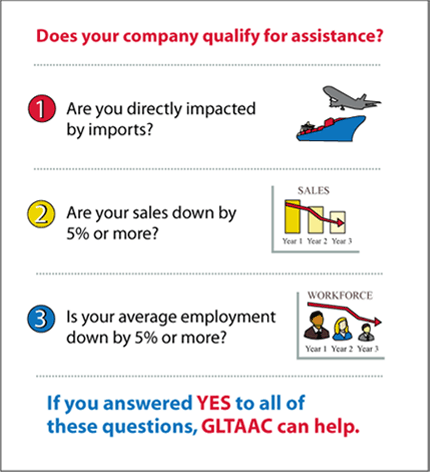
If you answered yes to these questions, it’s quite possible your company would qualify. Additionally, the following apply:
- Must be an independent company or wholly owned subsidiary with headquarters in Indiana, Michigan or Ohio.
- Must have been in business at least two years
GLTAAC will request the following as a first step in confirming your company’s TAAF eligibility:
- Net Sales by month for last 28 months
Eligibility requires declining net domestic sales (details here).
- Employee headcount by month for last 28 months
Monthly employment numbers must agree with your state unemployment insurance quarterly reports (details here).
- If net sales and average employment show at least a 5% decline, GLTAAC can begin to develop your TAAF Petition.
We’ll request additional information as we develop your application/Petition, including:
- Customer information – 4 customers with declining sales over the Petition period, including their contact information and sales volumes (details here).
- Financial statements for the two most recent fiscal years and and the Petition period, if different (details here).
- Descriptive summary information about your company
Related firms, ownership, managers and directors, products and markets, plant locations, other information about the firm required for the Petition.
All information is treated with the utmost confidentiality.

How We Do It
THE PROCESS
GLTAAC engagements entail three phases: qualify and apply to the TAAF program, assessment of the business, and implementation of business improvement projects. Through this process, companies qualify for up to $75,000 of assistance to support 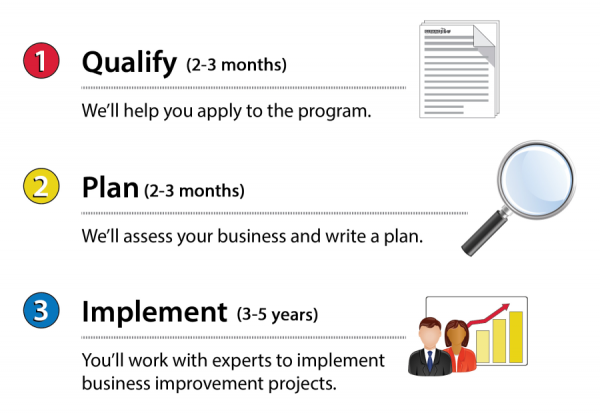 implementation projects.
Qualify: GLTAAC works with a firm to make sure they qualify for the TAAF program. Read more about qualifying here. GLTAAC will compile the actual application (called a Petition) from information provided by the firm.
Plan: Once approved for the program, a GLTAAC Project Manager works directly with the company to assess the business and develop a recovery plan (called an Adjustment Plan). The plan summarizes the company’s strengths and weaknesses. It then identifies and defines specific projects to improve competitiveness. Read more about the planning process here.
Implement: With its plan in place, the firm implements its projects with GLTAAC assisting with half the cost of projects. Companies have up to five years to complete the program. However, program support can sometimes be used at a faster pace of three years. More about projects is available here.
Program Costs
- Phase 1: The Application/Qualification Process is free
- Phase 2: The Planning & Assessment Process – 75% of the costs in this phase are covered by the Economic Development Administration. Typically, firms pay $1,000 – $2,000 to complete the business assessment phase.
- Phase 3: Implementation – Companies cover 50% of the cost to implement projects.
More ways to learn about GLTAAC and TAAF
These additional resources explain the TAAF process and benefits:
- GLTAAC Director, Scott Jacobs, discusses TAAF on Michigan Radio’s “Stateside/Next Idea” program. Listen to this short (11 minute) interview by going directly to the recording or to the link on the interview’s web page.
- Watch this video of Scott’s interview with the Farmington Hills, MI Economic Development Corporation:

Click to watch GLTAAC Director, Scott Jacobs, discuss the TAAF process (15 minutes) in an interview produced by the City of Farmington Hills, MI, Economic Development Corporation.